Ace - AI Tutor
Ask Our Educators
Textbooks
My Library
Flashcards
Scribe - AI Notes
Notes & Exams
Download App
Paulina Peterson

Paulina P.

Divider

Viewed Questions

A 63 -kg tightrope walker stands in the middle of a rope. Her weight makes the rope sag, with each half at a $9.5^{\circ}$ angle to the horizontal. (a) Make a force diagram for the walker. (b) Find the rope tension.

A 63 -kg tightrope walker stands in the middle of a rope. Her weight makes the rope sag, with each half at a $9.5^{\circ}$ angle to the horizontal. (a) Make a force diagram for the walker. (b) Find the rope tension.

Essential College Physics

Ice $\left(\rho=931 \mathrm{~kg} / \mathrm{m}^{3}\right)$ is floating in pure water. What fraction of the ice's volume is above the water's surface?

Ice $\left(\rho=931 \mathrm{~kg} / \mathrm{m}^{3}\right)$ is floating in pure water. What fraction of the ice's volume is above the water's surface?

Essential College Physics

Find the distance by which a $45-\mathrm{cm}$ -diameter, $8.9-\mathrm{m}$ -tall concrete column is compressed when it supports a $12,500-\mathrm{kg}$ load.

Find the distance by which a $45-\mathrm{cm}$ -diameter, $8.9-\mathrm{m}$ -tall concrete column is compressed when it supports a $12,500-\mathrm{kg}$ load.

Essential College Physics

Your car's fan belt turns a pulley at $3.40 \mathrm{rev} / \mathrm{s}$. When you step on the gas for $1.30 \mathrm{~s},$ the rate increases steadily to $5.50 \mathrm{rev} / \mathrm{s}$.
(a) What's the pulley's angular acceleration?
(b) Through what angle did the pulley turn while accelerating?

Your car's fan belt turns a pulley at $3.40 \mathrm{rev} / \mathrm{s}$. When you step on the gas for $1.30 \mathrm{~s},$ the rate increases steadily to $5.50 \mathrm{rev} / \mathrm{s}$. (a) What's the pulley's angular acceleration? (b) Through what angle did the pulley turn while accelerating?

Essential College Physics

Questions asked

INSTANT ANSWER

The naturally occurring charge on the ground on a fine day out in the open country is -1.00 \( \mathrm{nC} / \mathrm{m}^{2} \). What is the electric field relative to ground at a height of 3.50 m ? \[ -113 \mathrm{~V} / \mathrm{m} \] You are correct. Your receipt no. is \( 153-1785 \) Previous Tries Calculate the electric potential at this height. (You may want to sketch the electric field and equipotential lines for this scenario.) \[ 395.5 \mathrm{~V} \] Submit Answer Incorrect. Tries \( 1 / 99 \) Previous Tries

View Answer
divider
INSTANT ANSWER

Find the total capacitance of the combination of capacitors in the figure below.

View Answer
divider
ANSWERED

Vishal Gupta verified

Numerade educator

Potential energy of falling weights becomes kinetic energy of paddle. The paddle's kinetic energy in turn becomes internal energy of the water, indicated by rising temperature. FIGURE 13.1 Joule's apparatus for measuring what he called "the mechanical equivalent of heat." The masses of the two weights are both equal to 0.5 kg. (Neglect any inertia of the rest of the apparatus.) The masses fall 7 meters. Assume the mass of the water is 0.1 kg, and the water absorbs 75 percent of the heat. Calculate the rise in temperature of the water. (in degC) A: 2.786 B: 4.040 C: 5.857 D: 8.493 E: 12.315 F: 17.857 G: 25.893 H: 37.545

View Answer
divider
ANSWERED

Timothy James verified

Numerade educator

We drop an ice cube (mass = 81 grams) at 0∘C into a container of liquid water (mass = 580 grams) at 20∘C. Find the total change of entropy of the water when a common temperature has been reached.

View Answer
divider
ANSWERED

Hubert Agamasu verified

Numerade educator

Two identical balls, their masses 80.27 kg, experience mutual gravitational force of 8.8*10^-6 N. Find the distance between their centers.

View Answer
divider
ANSWERED

Jenny Wu verified

Numerade educator

84. Repeat the preceding problem for the Earth-Sun tidal interaction. You should find a greater solar acceleration in (a) and (b), but a smaller difference in (c), showing why the Sun's tidal effect is smaller than the Moon's despite the Sun's greater gravitational force on Earth.

View Answer
divider
ANSWERED

Nishant Kumar verified

Numerade educator

A crate is pulled at constant speed by a rope, across a floor with friction. m F ? 0 d coefficient of friction = ?k Data values: m = 45 kg, ? = 31 deg, ?k = 0.36, d = 8.2 m. Find the work done, (a) by friction, and (b) by the tension force of the rope.

View Answer
divider
ANSWERED

Breanna Ollech verified

Numerade educator

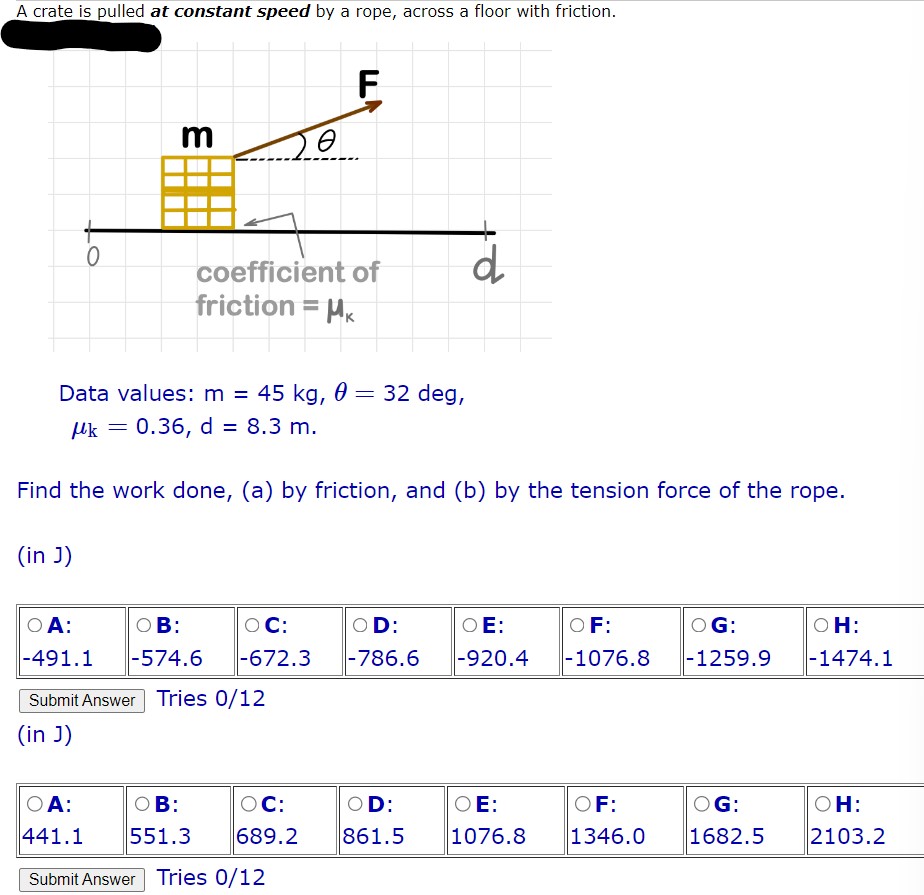
A crate is pulled at constant speed by a rope, across a floor with friction. m F ? 0 coefficient of friction = ?? d Data values: m = 45 kg, ? = 32 deg, ?? = 0.36, d = 8.3 m. Find the work done, (a) by friction, and (b) by the tension force of the rope. (in J) A: -491.1 B: -574.6 C: -672.3 D: -786.6 E: -920.4 F: -1076.8 G: -1259.9 H: -1474.1 (in J) A: 441.1 B: 551.3 C: 689.2 D: 861.5 E: 1076.8 F: 1346.0 G: 1682.5 H: 2103.2
View Answer
divider
ANSWERED

Joshua Bell verified

Numerade educator

(D) See the figure. The pulley is a disk with mass M, radius R, and moment of inertia I. Let ? be the angle of rotation of the pulley; and let ?' be the angular velocity. (i) Write the total kinetic energy of the system in terms of ?'. (ii) Write the gravitational potential energy in terms of ?. (iii) The total energy has the form 1/2 ? ?'² - ? ?, so use part A to determine the angular acceleration. (iv) If M = 0, what is ?? (v) If M = m, what is ??

View Answer
divider
ANSWERED

Supratim Pal verified

Numerade educator

A solid rubber sphere rolls from rest down the 45-degree incline (no sliding). The total energy is frac{1}{2} mu omega^{2}-Gamma heta; (you figure out mu and Gamma) The angle of rotation is heta=L / R where L = distance from the starting point. Calculate the time when L = 1.3 m. 0.6126 s Use the previous problem to determine the angular acceleration.

View Answer
divider