Ace - AI Tutor
Ask Our Educators
Textbooks
My Library
Flashcards
Scribe - AI Notes
Notes & Exams
Download App
Princess

Princess

Divider

Viewed Questions

Two parallel plates 10 cm on a side are given equal and opposite charges of magnitude $5.0 \times 10^{-9}$ C. The plates are $1.5 \mathrm{mm}$ apart. What is the electric field at the center of the region between the plates?

Two parallel plates 10 cm on a side are given equal and opposite charges of magnitude $5.0 \times 10^{-9}$ C. The plates are $1.5 \mathrm{mm}$ apart. What is the electric field at the center of the region between the plates?

University Physics

Find $d y / d x$ by implicit differentiation.
$\sin x \cos y=x^{2}-5 y$

Find $d y / d x$ by implicit differentiation. $\sin x \cos y=x^{2}-5 y$

Calculus: Early Transcendentals, Metric Edition

Differentiation Rules

Implicit Differentiation

Use the following equilibria
$$
\begin{aligned}
2 \mathrm{CH}_{4}(g) & \rightleftharpoons \mathrm{C}_{2} \mathrm{H}_{6}(g)+\mathrm{H}_{2}(g) & K_{\mathrm{c}} &=9.5 \times 10^{-13} \\
\mathrm{CH}_{4}(g)+\mathrm{H}_{2} \mathrm{O}(g) & \rightleftharpoons \mathrm{CH}_{3} \mathrm{OH}(g)+\mathrm{H}_{2}(g) K_{\mathrm{c}} &=2.8 \times 10^{-21}
\end{aligned}
$$
to calculate $K_{\mathrm{c}}$ for the reaction
$$
2 \mathrm{CH}_{3} \mathrm{OH}(g)+\mathrm{H}_{2}(g) \rightleftharpoons \mathrm{C}_{2} \mathrm{H}_{6}(g)+2 \mathrm{H}_{2} \mathrm{O}(g)
$$

Use the following equilibria $$ \begin{aligned} 2 \mathrm{CH}_{4}(g) & \rightleftharpoons \mathrm{C}_{2} \mathrm{H}_{6}(g)+\mathrm{H}_{2}(g) & K_{\mathrm{c}} &=9.5 \times 10^{-13} \\ \mathrm{CH}_{4}(g)+\mathrm{H}_{2} \mathrm{O}(g) & \rightleftharpoons \mathrm{CH}_{3} \mathrm{OH}(g)+\mathrm{H}_{2}(g) K_{\mathrm{c}} &=2.8 \times 10^{-21} \end{aligned} $$ to calculate $K_{\mathrm{c}}$ for the reaction $$ 2 \mathrm{CH}_{3} \mathrm{OH}(g)+\mathrm{H}_{2}(g) \rightleftharpoons \mathrm{C}_{2} \mathrm{H}_{6}(g)+2 \mathrm{H}_{2} \mathrm{O}(g) $$

Chemistry: The Molecular Nature of Matter

Questions asked

INSTANT ANSWER

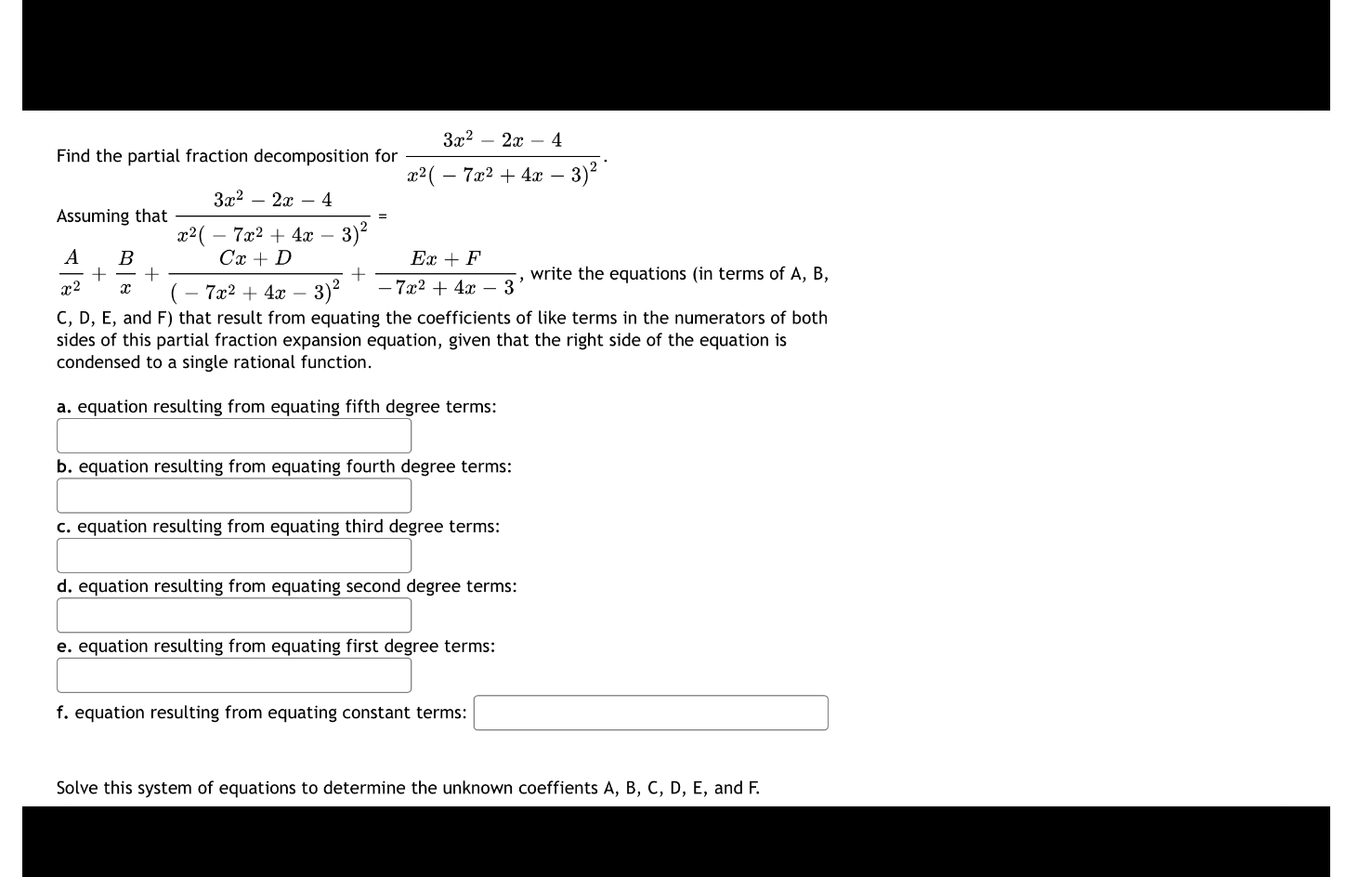
Find the partial fraction decomposition for \( \frac{3 x^{2}-2 x-4}{x^{2}\left(-7 x^{2}+4 x-3\right)^{2}} \). Assuming that \( \frac{3 x^{2}-2 x-4}{x^{2}\left(-7 x^{2}+4 x-3\right)^{2}}= \) \( \frac{A}{x^{2}}+\frac{B}{x}+\frac{C x+D}{\left(-7 x^{2}+4 x-3\right)^{2}}+\frac{E x+F}{-7 x^{2}+4 x-3} \), write the equations (in terms of A, B, \( C, D, E \), and F) that result from equating the coefficients of like terms in the numerators of both sides of this partial fraction expansion equation, given that the right side of the equation is condensed to a single rational function. a. equation resulting from equating fifth degree terms: \( \square \) b. equation resulting from equating fourth degree terms: \( \square \) c. equation resulting from equating third degree terms: \( \square \) d. equation resulting from equating second degree terms: \( \square \) e. equation resulting from equating first degree terms: \( \square \) f. equation resulting from equating constant terms: \( \square \) Solve this system of equations to determine the unknown coeffients \( \mathrm{A}, \mathrm{B}, \mathrm{C}, \mathrm{D}, \mathrm{E} \), and F .
View Answer
divider
ANSWERED

Breanna Ollech verified

Numerade educator

Given the power series sum_{n=0}^{infty} frac{x^n}{3^n} = 1 + frac{x}{3} + frac{x^2}{3^2} + frac{x^3}{3^3} + frac{x^4}{3^4} + ... Find frac{d}{dx} sum_{n=0}^{infty} frac{x^n}{3^n} = frac{d}{dx} (1 + frac{x}{3} + frac{x^2}{3^2} + frac{x^3}{3^3} + frac{x^4}{3^4} + ...) by differentiating term by term. Write the first 5 terms below, simplifying any powers of -1. [ ] + [ ] + [ ] + [ ] + [ ] + ... Write the series compactly using summation notation (if the series alternates, include the alternator separately): sum_{n=1}^{infty} [ ] (Notice that since the constant term was dropped, we start the summation at n = 1.) Find the interval of convergence for the new series. [ ]

View Answer
divider
ANSWERED

Breanna Ollech verified

Numerade educator

by differentiating term by term. Write the first 5 terms below, simplifying any powers of -1. frac{1}{3} + frac{2x}{9} + frac{3x^{2}}{27} + frac{4x^{3}}{81} + frac{5x^{4}}{243} + ... Write the series compactly using summation notation (if the series alternates, include the alternator separately):

View Answer
divider
ANSWERED

Sam Stansfield verified

Numerade educator

16. A fence 6 feet tall runs parallel to a tall building at a distance of 2 ft from the building as shown in the diagram. Find the length of the shortest ladder that will reach from the ground over the fence to the wall of the building (grandMOM, question ID: 681639).

View Answer
divider
ANSWERED

Gregory Higby verified

Numerade educator

12. Consider the equation ( mathrm{e}^{x}=-3 x ). (a) Use the Intermediate Value Theorem to prove that the equation has a solution.

View Answer
divider
ANSWERED

Taha T verified

Numerade educator

The displacement (in centimeters) of a particle moving along a straight line is given by [ s(t)=frac{t^{3}}{3}-t^{2}-3 t ] where ( t ) is measured in seconds. (a) Find the average velocity of the particle between ( t=1 ) and ( t=3 ).

View Answer
divider
INSTANT ANSWER

Use l'Hospital's Rule to evaluate the following limit. At each step where l'Hôspital's Rule is applied, indicate the indeterminate form of the limit. \[ \lim _{\theta \rightarrow \frac{\pi}{2}} \frac{1-\sin \theta}{1+\cos 2 \theta} \]

View Answer
divider
INSTANT ANSWER

9. An electron \( \left(m_{e}=9.11 \times 10^{-31} \mathrm{~kg}, q=-1.60 \times 10^{-19} \mathrm{C}\right) \) moves in a circular path in the uniform magnetic field produced inside a solenoid. a) The sketch below shows an end-on view of the solenoid (direction of current is indicated) and the electron's path (dashed line). Indicate: i) The direction of the magnetic field produced by the solenoid. ii) The direction of the electron's orbit.

View Answer
divider
INSTANT ANSWER

Consider a compass placed at the indicated (dot) locations in the following magnetic fields in the image below. Which direction does the North pole of the compass point in (a)? Choose... Which direction does the North pole of the compass point in (b)? Choose... Which direction does the North pole of the compass point in (c)? Choose... Check

View Answer
divider
INSTANT ANSWER

Three charges with identical charge of \( \mathrm{Q}=79 \mathrm{nC} \) are placed on the corners of an equilateral triangle of side-length \( d=5.1 \mathrm{~cm} \). What is the net upward force (in \( N \) ) on the charge at the top of the triangle?

View Answer
divider