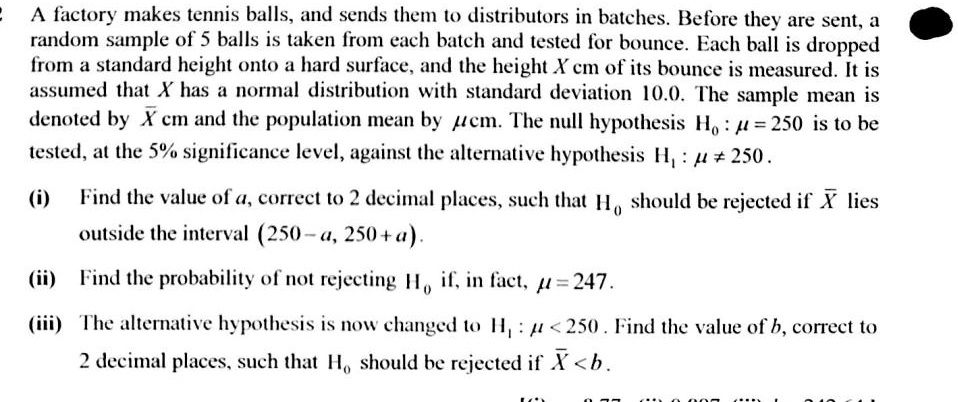
A factory makes tennis balls, and sends them to distributors in batches. Before they are sent, a
random sample of 5 balls is taken from each batch and tested for bounce. Each ball is dropped
from a standard height onto a hard surface, and the height X cm of its bounce is measured. It is
assumed that X has a normal distribution with standard deviation 10.0. The sample mean is
denoted by \( \bar{X} \) cm and the population mean by \( \mu \)cm. The null hypothesis \( H_0: \mu = 250 \) is to be
tested, at the 5% significance level, against the alternative hypothesis \( H_1: \mu \neq 250 \).
(i)
Find the value of a, correct to 2 decimal places, such that \( H_0 \) should be rejected if \( \bar{X} \) lies
outside the interval (250-a, 250+a).
(ii) Find the probability of not rejecting \( H_0 \), if, in fact, \( \mu = 247 \).
(iii) The alternative hypothesis is now changed to \( H_1: \mu < 250 \). Find the value of b, correct to
2 decimal places, such that \( H_0 \) should be rejected if \( \bar{X} < b \).