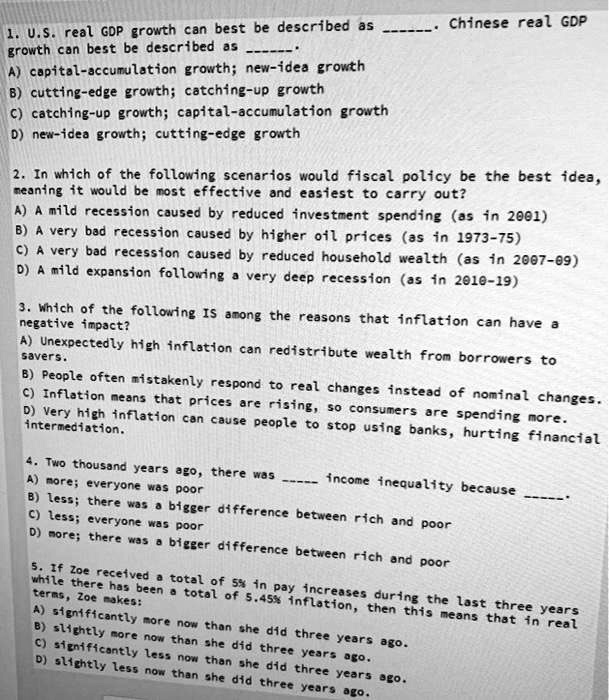
1. U.S. real GDP growth can best be described as:
A) capital-accumulation growth; new-idea growth
B) cutting-edge growth; catching-up growth
C) catching-up growth; capital-accumulation growth
D) new-idea growth; cutting-edge growth
2. In which of the following scenarios would fiscal policy be the best idea, meaning it would be most effective and easiest to carry out?
A) A mild recession caused by reduced investment spending (as in 2001)
B) A very bad recession caused by reduced household wealth (as in 2007-09)
C) A mild expansion following a very deep recession (as in 2016-19)
3. Which of the following is among the reasons that inflation can have a negative impact?
A) Unexpectedly high inflation can redistribute wealth from borrowers to savers.
B) People often mistakenly respond to real changes instead of nominal changes.
C) Inflation means that prices are rising, so consumers are spending more.
D) Very high inflation can cause people to stop using banks, hurting financial intermediation.
4. Two thousand years ago, there was:
A) no income inequality because everyone was poor
B) less income inequality because there was a bigger difference between rich and poor
C) less income inequality because everyone was poor
D) more income inequality because there was a bigger difference between rich and poor
5. If there has been a total of 5.45% inflation, then this means that in real terms:
A) prices have increased by 5.45%
B) prices have decreased by 5.45%
C) prices have increased by 5.45% and wages have increased by the same amount
D) prices have increased by 5.45% and wages have decreased by the same amount
6. If Zoe received a total of 5% in pay increases during the last three years, then this means that in real terms, Zoe makes:
A) significantly more now than she did three years ago
B) slightly more now than she did three years ago
C) slightly less now than she did three years ago
D) significantly less now than she did three years ago.