Ace - AI Tutor
Ask Our Educators
Textbooks
My Library
Flashcards
Scribe - AI Notes
Notes & Exams
Download App
rachel amores

rachel a.

Divider

Questions asked

BEST MATCH

Which of the following is NOT a component of culture? Norms Values Laws Self-identity

View Answer
divider
BEST MATCH

What are —“self-feeders” that sustain themselves without eating anything derived from other organisms

View Answer
divider
BEST MATCH

find the voulme of the soild obtained by rotating the region bounded by y=x^2, y=0, and x=5 about the y axis

View Answer
divider
BEST MATCH

How do experts versus nonexperts differ in terms of how they create categories, if at all?ta. Both experts and nonexperts tend to create categories in the same way.ttb. Experts tend to use more specific categories. whereas nonexperts use more basic categories.ttc. Nonexperts tend to use more specific categories, whereas experts use more basic categories.ttd. To the degree that there may be differences between experts and nonexperts in terms of category creations, they tend to focus around gender differences.t

View Answer
divider
BEST MATCH

3: Harm is the damage that all rational people want to avoid for themselves or for those close to them. True False

View Answer
divider
BEST MATCH

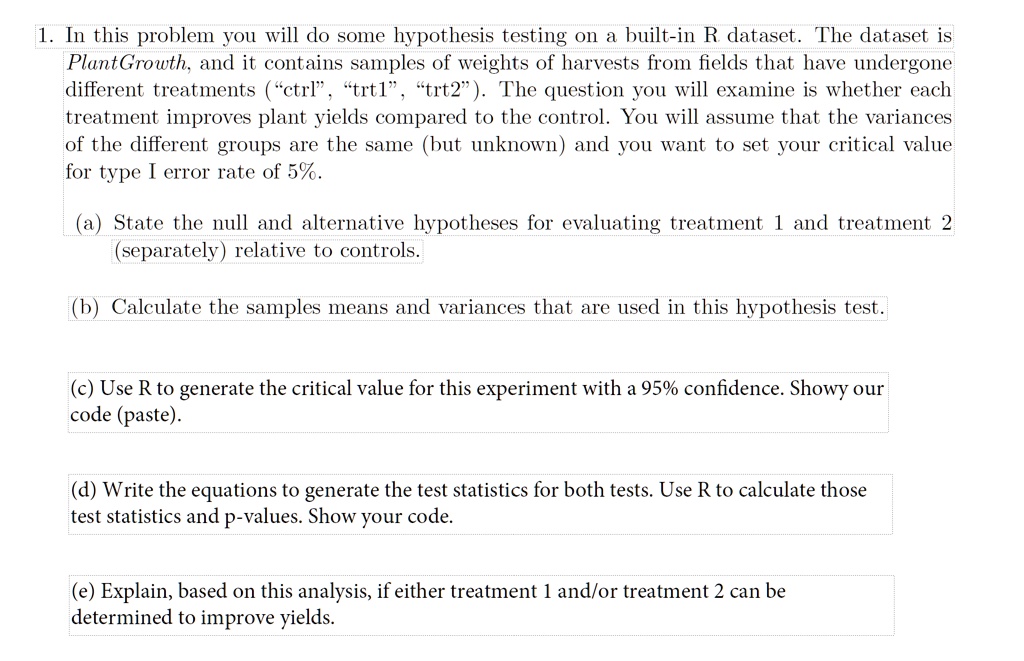
1. In this problem you will do some hypothesis testing on a built-in R dataset. The dataset is PlantGrowth, and it contains samples of weights of harvests from fields that have undergone different treatments ("ctrl", "trt1", "trt2"). The question you will examine is whether each treatment improves plant yields compared to the control. You will assume that the variances of the different groups are the same (but unknown) and you want to set your critical value for type I error rate of 5%. (a) State the null and alternative hypotheses for evaluating treatment 1 and treatment 2 (separately) relative to controls. (b) Calculate the samples means and variances that are used in this hypothesis test. (c) Use R to generate the critical value for this experiment with a 95% confidence. Showy our code (paste). (d) Write the equations to generate the test statistics for both tests. Use R to calculate those test statistics and p-values. Show your code. (e) Explain, based on this analysis, if either treatment 1 and/or treatment 2 can be determined to improve yields.
View Answer
divider
BEST MATCH

Refer to the circuit in Figure 1(b) below: (i) Find the Thevenin resistance, Rth (ii) Find the Thevenin voltage, Vth WW R2 = 4 WWM R4 = 1 R3 = 5 RL = 10 Figure 1(b)

View Answer
divider
BEST MATCH

Question 1 A steel pipe with grade A53 grade A Type E in the attachment 1 is portion of raw material need to be used in underwater welding for new ferry terminal in Langkawi. As a welding engineer your need to study the quality of the welding joint prior to commence the construction works. (a.) From the IIW carbon equivalent ($C_{eq}$) formula Calculate the carbon equivalence ($C_{eq}$) for A53, grade A pipe produced by electric resistance welding process. (b.) (c.) Name the main and secondary elements for $C_{eq}$ contributor in (a) by formula and from the actual figure. (d.) Discuss why we need to take consideration the $C_{eq}$ number in underwater welding? (15 marks)

View Answer
divider
BEST MATCH

The graph of $f(x) = 2^x$ is shown in the diagram below. Using this graph, solve the equation: $2^x = 4.6$, stating the best approximate value of $x$.

View Answer
divider
BEST MATCH

Home Work 2: A source emits independent seguanse of symbol alphabt contating four symbols as showen below: P(A) =0.5 P(B)=0.1 P(C) = 0.3 P(D)= 0.1 See the Example 3.3 (1) & solution by same steps: i) Compute the entropy of the source ii) Design a source encoder with a block size of two.

View Answer
divider