Cxetcise D: UIvA Kepilation (con t)
Initiation of replication (con't)
1. How would you convert a spring into a straight piece of metal using the same approach as topoisomerase in DNA replication?
\begin{tabular}{|c|c|}
\hline & KEY \\
\hline [ \( [ \) ] - Cytosine & 0 - SSBP \\
\hline\( \ \) - Adenine & 1.- Helicase \\
\hline [?]-Guanine & (3)- DNA Polymerase I \\
\hline (i)-Thymine & (2)- DNA Polymerase II \\
\hline (1)- Uracil & (3)- DNA Polymerase III \\
\hline (1) - Deoxyribose & - Primase \\
\hline (1)-Ribose & D-Ligase \\
\hline (P) - Phosphate & - Telomerase \\
\hline
\end{tabular}
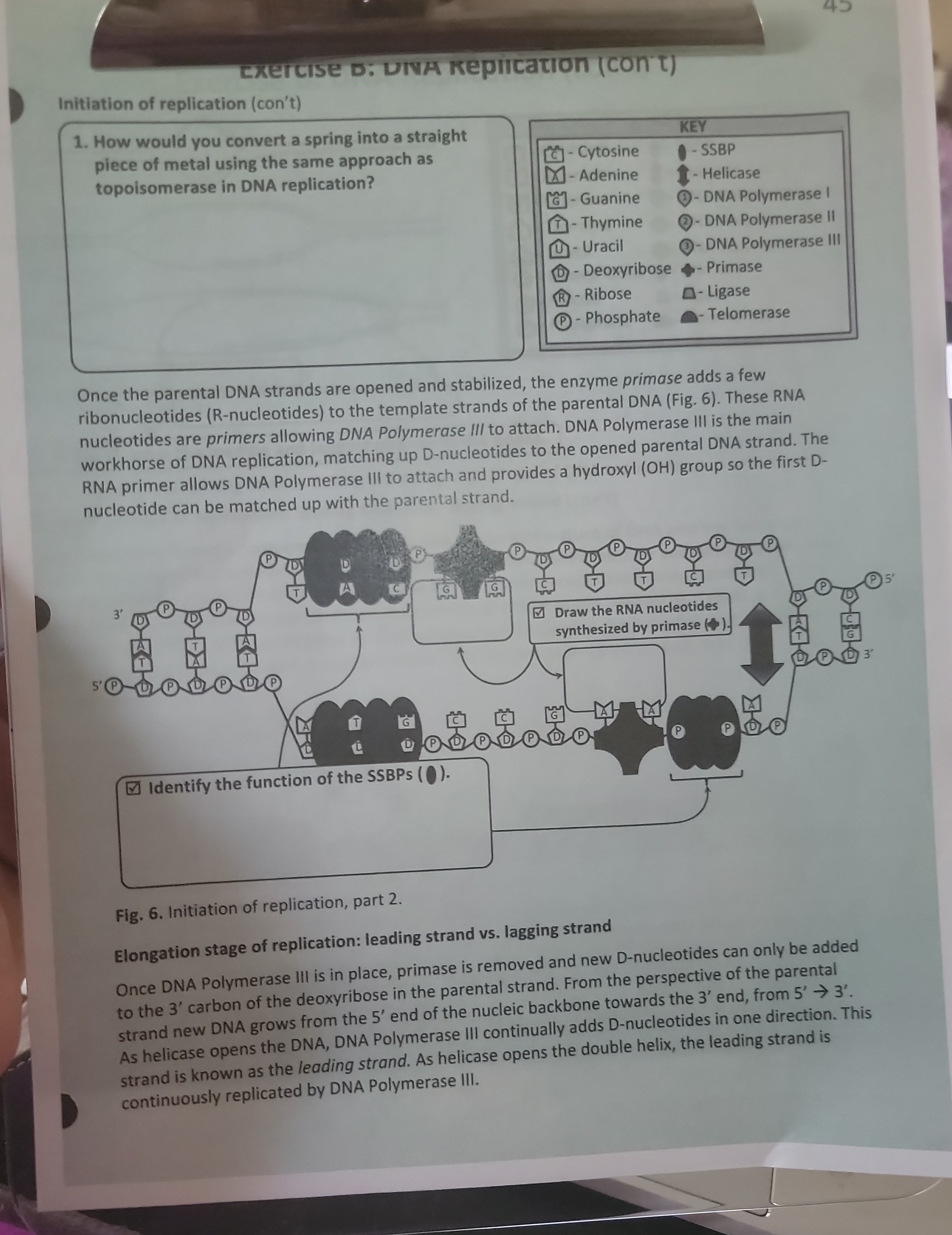
Once the parental DNA strands are opened and stabilized, the enzyme primase adds a few ribonucleotides (R-nucleotides) to the template strands of the parental DNA (Fig. 6). These RNA nucleotides are primers allowing DNA Polymerase III to attach. DNA Polymerase III is the main workhorse of DNA replication, matching up D-nucleotides to the opened parental DNA strand. The RNA primer allows DNA Polymerase III to attach and provides a hydroxyl \( (\mathrm{OH}) \) group so the first Dnucleotide can be matched up with the parental strand.
Fig. 6. Initiation of replication, part 2.
Elongation stage of replication: leading strand vs. lagging strand
Once DNA Polymerase III is in place, primase is removed and new D-nucleotides can only be added to the \( 3^{\prime} \) carbon of the deoxyribose in the parental strand. From the perspective of the parental strand new DNA grows from the \( 5^{\prime} \) end of the nucleic backbone towards the \( 3^{\prime} \) end, from \( 5^{\prime} \rightarrow 3^{\prime} \). As helicase opens the DNA, DNA Polymerase III continually adds D-nucleotides in one direction. This strand is known as the leading strand. As helicase opens the double helix, the leading strand is continuously replicated by DNA Polymerase III.