Ace - AI Tutor
Ask Our Educators
Textbooks
My Library
Flashcards
Scribe - AI Notes
Notes & Exams
Download App
rachel hubbard

rachel h.

Divider

Questions asked

BEST MATCH

One Way ANOVA N 3 5 6 4 S 12 3 2 10 11 E 15 14 2 10 6. At 5% significnt level, does the data provide sufficient evidence to conclude that a difference exists in mean amount of rain among the threee different cities.

View Answer
divider
BEST MATCH

0.0104649 km 403.5cm 3.81m 0.009350 km 3048.5mm 403.5cm 35cm 598cm 0.009350 km 7.95m 48.5cm 3.81m 0.0104649 km 1.3. Determine what percentage of the area of the rectangle in Question (1.2) is shaded. Show all workings. (4)

View Answer
divider
BEST MATCH

Solve the system by the method of substitution. (If there is no solution, enter NO SOLUTION.) 0.3x + y = -3.5 x - 3.3y = 1.6

View Answer
divider
BEST MATCH

Economist 2 is more likely to favor the proposed change in monetary policy. $ ola

View Answer
divider
BEST MATCH

Diagonalize the matrix \begin{bmatrix} -10 & 6 \\ -12 & 8 \end{bmatrix} by writing it as A = PDP$^{-1}$ P = D = P$^{-1}$ =

View Answer
divider
BEST MATCH

Economists Thomas Piketty and Emmanuel Saez have studied income inequality using data from the Current Population Survey (CPS) and tax data from the Internal Revenue Service (IRS). They find that A-The Gini coefficient calculated using only tax data is smaller than the Gini coefficient using CPS data and it increases more slowly from 1976 to 2006 B-The top 1% income share decreases from 1976 to 2006 when CPS data is combined with tax data excluding capital gains C- The top 1% income share increases from 1976 to 2006 only because of changes in the tax law (we don’t see an increase using only CPS data) D- The Gini coefficient calculated from CPS data combined with tax data is rising faster from 1976 to 2006 when it includes capital gains incomes

View Answer
divider
BEST MATCH

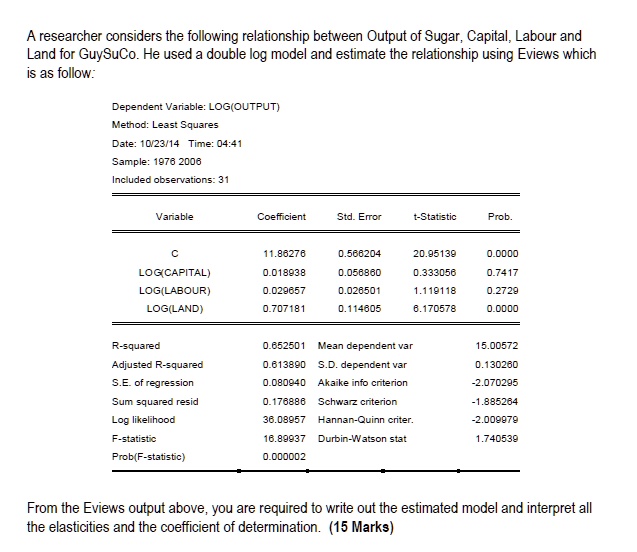
A researcher considers the following relationship between Output of Sugar, Capital, Labour and Land for GuySuCo. He used a double log model and estimate the relationship using Eviews which is as follow: Dependent Variable: LOG(OUTPUT) Method: Least Squares Date: 10/23/14 Time: 04:41 Sample: 1976 2006 Included observations: 31 Variable\tCoefficient\tStd. Error\tt-Statistic\tProb. C\t11.86276\t0.566204\t20.95139\t0.0000 LOG(CAPITAL)\t0.018938\t0.056860\t0.333056\t0.7417 LOG(LABOUR)\t0.029657\t0.026501\t1.119118\t0.2729 LOG(LAND)\t0.707181\t0.114605\t6.170578\t0.0000 R-squared\t0.652501\tMean dependent var\t15.00572 Adjusted R-squared\t0.613890\tS.D. dependent var\t0.130260 S.E. of regression\t0.080940\tAkaike info criterion\t-2.070295 Sum squared resid\t0.176886\tSchwarz criterion\t-1.885264 Log likelihood\t36.08957\tHannan-Quinn criter.\t-2.009979 F-statistic\t16.89937\tDurbin-Watson stat\t1.740539 Prob(F-statistic)\t0.000002 From the Eviews output above, you are required to write out the estimated model and interpret all the elasticities and the coefficient of determination. (15 Marks)
View Answer
divider
BEST MATCH

A 50-Hz single-phase, two-wire overhead line employs a single stranded conductor per phase arranged horizontally with 1.2 m conductor spacing. Each of the conductors consists of six outer strands surrounding and touching one central strand. All strands have a radius of 1.5 cm. Calculate: 1. the conductor GMR (as a dimensionless ratio) 2. the total loop inductance in H/km of the line 3. the positive-sequence capacitance in F/m, neglecting the effect of earth 4. for an average line height of 5 m, determine and state clearly the effect of earth 5. calculate the conductor electric field strength in V/m when the line is operating at 11 kV 6. the ground-level electric field strength in V/m directly under one conductor.

View Answer
divider
BEST MATCH

2. Data Set 2: 6 6 7 10 12 14 15 15 For each set of data find: a) The mode b) The median c) The mean (correct to one decimal place) d) The range e) The lower quartile f) The upper quartile g) The interquartile range

View Answer
divider
BEST MATCH

1234567891011121314151617 L?P TOÁN CÔ HI?N – KH?I 8 - 1. Cho tam giĂĄc ABC cĂł AB = 4cm, AC = 7cm. G?i BH, CK theo th? t? lĂ  ???ng cao h? t? ??nh B vĂ  C c?a tam giĂĄc. TĂ­nh BH/CK. (vi?t ?Ășng t? s?)

View Answer
divider