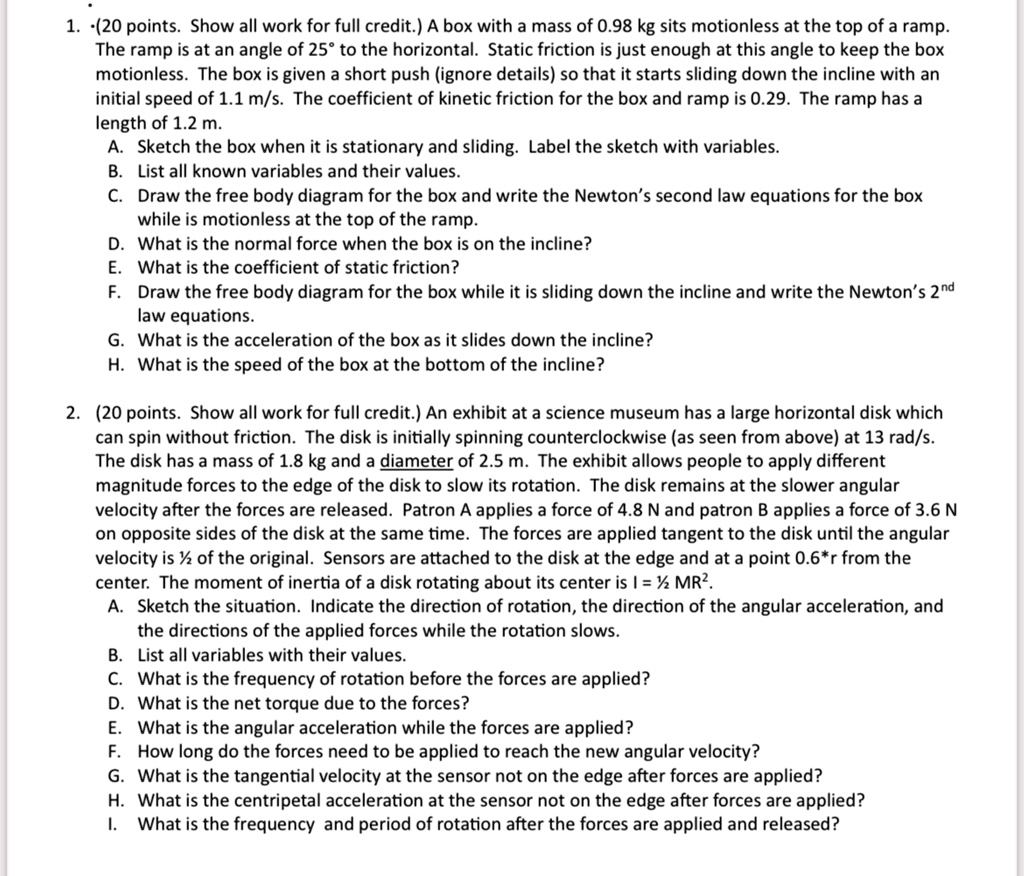
1. (20 points. Show all work for full credit.) A box with a mass of 0.98 kg sits motionless at the top of a ramp.
The ramp is at an angle of 25° to the horizontal. Static friction is just enough at this angle to keep the box
motionless. The box is given a short push (ignore details) so that it starts sliding down the incline with an
initial speed of 1.1 m/s. The coefficient of kinetic friction for the box and ramp is 0.29. The ramp has a
length of 1.2 m.
A. Sketch the box when it is stationary and sliding. Label the sketch with variables.
B. List all known variables and their values.
C. Draw the free body diagram for the box and write the Newton's second law equations for the box
while is motionless at the top of the ramp.
D. What is the normal force when the box is on the incline?
E. What is the coefficient of static friction?
F. Draw the free body diagram for the box while it is sliding down the incline and write the Newton's 2nd
law equations.
G. What is the acceleration of the box as it slides down the incline?
H. What is the speed of the box at the bottom of the incline?
2. (20 points. Show all work for full credit.) An exhibit at a science museum has a large horizontal disk which
can spin without friction. The disk is initially spinning counterclockwise (as seen from above) at 13 rad/s.
The disk has a mass of 1.8 kg and a diameter of 2.5 m. The exhibit allows people to apply different
magnitude forces to the edge of the disk to slow its rotation. The disk remains at the slower angular
velocity after the forces are released. Patron A applies a force of 4.8 N and patron B applies a force of 3.6 N
on opposite sides of the disk at the same time. The forces are applied tangent to the disk until the angular
velocity is ½ of the original. Sensors are attached to the disk at the edge and at a point 0.6*r from the
center. The moment of inertia of a disk rotating about its center is I = 1½ MR2.
A. Sketch the situation. Indicate the direction of rotation, the direction of the angular acceleration, and
the directions of the applied forces while the rotation slows.
B. List all variables with their values.
C. What is the frequency of rotation before the forces are applied?
D. What is the net torque due to the forces?
E. What is the angular acceleration while the forces are applied?
F. How long do the forces need to be applied to reach the new angular velocity?
G. What is the tangential velocity at the sensor not on the edge after forces are applied?
H. What is the centripetal acceleration at the sensor not on the edge after forces are applied?
I. What is the frequency and period of rotation after the forces are applied and released?