Ace - AI Tutor
Ask Our Educators
Textbooks
My Library
Flashcards
Scribe - AI Notes
Notes & Exams
Download App
rachel rebollo

rachel r.

Divider

Questions asked

BEST MATCH

A bipolar differential amplifier with I = 0.2 mAutilizes transistors for which V = 20 V and B = 100. Thecollector resistances R = 10 k$2 and are matched to within10%. Find:(a) the differential gain(b) the common-mode gain and the CMRR if the bias currentI is generated using a simple current mirror

View Answer
divider
BEST MATCH

The power and thickness of the lacrimal lens will vary with the: refraction lens-cornea relationship lens thickness

View Answer
divider
BEST MATCH

research on IoT based Smart Agriculture Monitoring System using the LTE network.

View Answer
divider
BEST MATCH

6. Which of the following is true? a) \( K>1, \Delta G^{\circ} \quad \) rxn is positive c) \( \Delta G^{\circ}{ }_{\mathrm{rxn}}=0 \) at equilibrium b) \( K<1, \Delta G^{\circ} \quad \) rxn is negative d) \( \Delta G_{\mathrm{rxn}}=0 \) at equilibrium e) None of the above are true

View Answer
divider
BEST MATCH

The charge on an object that contains 8.41 x 10^19 excess protons is given by the formula: Charge = (Number of protons) x (Elementary charge) Given that the elementary charge is approximately 1.6 x 10^-19 coulombs, the charge on the object can be calculated as follows: Charge = 8.41 x 10^19 protons x 1.6 x 10^-19 C/proton Charge = 13.456 x 10^0 C Therefore, the charge on the object is 13.456 coulombs.

View Answer
divider
BEST MATCH

18. Consider the following liquid-phase reaction is taking place into CSTR reactor: A?2C+D. Given that the feed is pure A, the inlet concentration of the feed = 1 mol/L. k = 0.42 L.mol$^{-1}$.h$^{-1}$. The reaction is 2$^{nd}$ order in A. The inlet volumetric = 10 L/h. The outlet flow rate of C = 18 mol. Calculate the following: a- Outlet concentration of A. b- Outlet flow rate of A and D. c- Reactor volume.

View Answer
divider
BEST MATCH

k M(t) Question PSS10-Q1. The system shown in the figure below is composed of: \begin{itemize} \item One disc of radius $r = 0.5$ m, mass $m_1 = 3$ kg moments of inertia $I_1 = 0.375$ kg\text{-}m^2$, with respect to its centre and centre of mass, which is pinned to the ground. The disc rotates about its centre and the quantity $\theta_1$ defines its rotation angle (positive CCW). \item A second disc of radius $r = 0.5$ m, mass $m_2 = 5$ kg moments of inertia $I_2 = 0.625$ kg\text{-}m^2$, with respect to its centre and centre of mass, which is pinned to the ground. The disc rotates about its centre and the quantity $\theta_2$ defines its rotation angle (positive CCW). \item A point mass $m_3 = 1$ kg, constrained to move only vertically. \end{itemize} A torsional spring of stiffness $k_t = 10$ N\text{-}m/rad connects the first disc to the ground, and a flexible cable of stiffness $k = 100$ N/m connects the two discs. All springs are unstretched for $\theta_1 = 0$ and $\theta_2 = 0$. An inextensible cable connects the second disc to the point mass. An external moment $M(t) = M_0 \cos(\omega t)$ is applied to the second disc, with $M_0 = 0.3$ N\text{-}m and $\omega = 4$ rad/s. At home, you can complete the following parts a) Show that $\theta_1 = -0.4905$ rad and $\theta_2 = -0.6867$ rad is a stable equilibrium position b) Show that mass and stiffness matrices are: $M = \begin{bmatrix} 0.375 & 0\\ 0 & 0.875 \end{bmatrix}$ kg\text{-}m$^2$ and $K = \begin{bmatrix} 35 & -25\\ -25 & 25 \end{bmatrix}$ N\text{-}m/rad

View Answer
divider
BEST MATCH

(1 point) Solve the given initial value problem \(xy^2y = y^3 - 4x^3\) \(y(1) = 6\) \(y(x) =\)

View Answer
divider
BEST MATCH

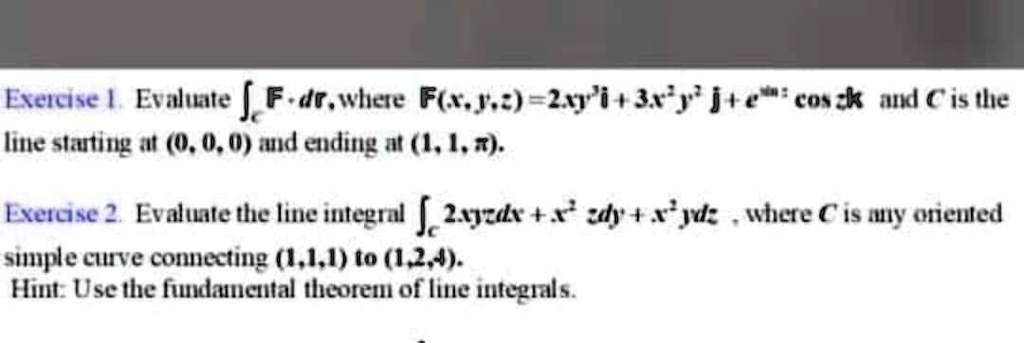
Exercise 1. Evaluate $\int_C \mathbf{F} \cdot d\mathbf{r}$, where $\mathbf{F}(x, y, z) = 2xy^2 \mathbf{i} + 3x^2 y^2 \mathbf{j} + e^z \cos z \mathbf{k}$ and $C$ is the line starting at $(0, 0, 0)$ and ending at $(1, 1, \pi)$.\newline Exercise 2. Evaluate the line integral $\int_C 2xyzdx + x^2zdy + x^2ydz$, where $C$ is any oriented simple curve connecting $(1, 1, 1)$ to $(1, 2, 4)$.\newline Hint: Use the fundamental theorem of line integrals.
View Answer
divider
BEST MATCH

Question 20 Calcium and oxygen form an ionic compound with the formula ________. CaO Ca?O CaO? Ca?O? Ca?O? 1 pts

View Answer
divider