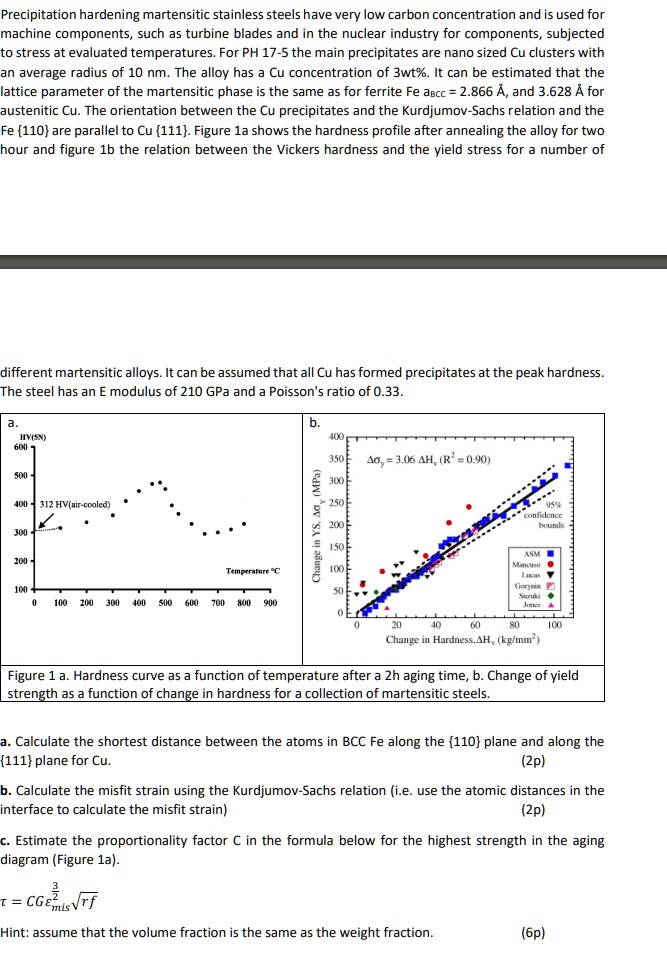
Texts: Precipitation hardening martensitic stainless steels have very low carbon concentration and are used for machine components, such as turbine blades, and in the nuclear industry for components subjected to stress at elevated temperatures. For PH 17-5, the main precipitates are nano-sized Cu clusters with an average radius of 10 nm. The alloy has a Cu concentration of 3 wt%. It can be estimated that the lattice parameter of the martensitic phase is the same as for ferrite Fe (a_cc = 2.866 Å) and 3.628 Å for austenitic Cu. The orientation between the Cu precipitates and the Kurdjumov-Sachs relation is shown in Figure 1b, along with the relation between the Vickers hardness and the yield stress for a number of different martensitic alloys. It can be assumed that all Cu has formed precipitates at the peak hardness. The steel has an E modulus of 210 GPa and a Poisson's ratio of 0.33.
a. HV(SN) = 600
b. 350 MPa
50
= 3.06 H (R^2 = 0.90)
500 -
400 312 HV(air-cooled)
95% confidence bounds
300
200
150
200
WSV
Temperature (°C)
Locas Goryain Senoki
100
0
100 200 300 400 500 600 700
900
0
20 40 60 80 100 Change in Hardness, H (kg/mm^2)
Figure 1a: Hardness curve as a function of temperature after a 2h aging time
Figure 1b: Change of yield strength as a function of change in hardness for a collection of martensitic steels.
a. Calculate the shortest distance between the atoms in BCC Fe along the {110} plane and along the {111} plane for Cu. (2p)
b. Calculate the misfit strain using the Kurdjumov-Sachs relation (i.e., use the atomic distances in the interface to calculate the misfit strain). (2p)
c. Estimate the proportionality factor C in the formula below for the highest strength in the aging diagram (Figure 1a):
3
Hint: Assume that the volume fraction is the same as the weight fraction.
(6p)