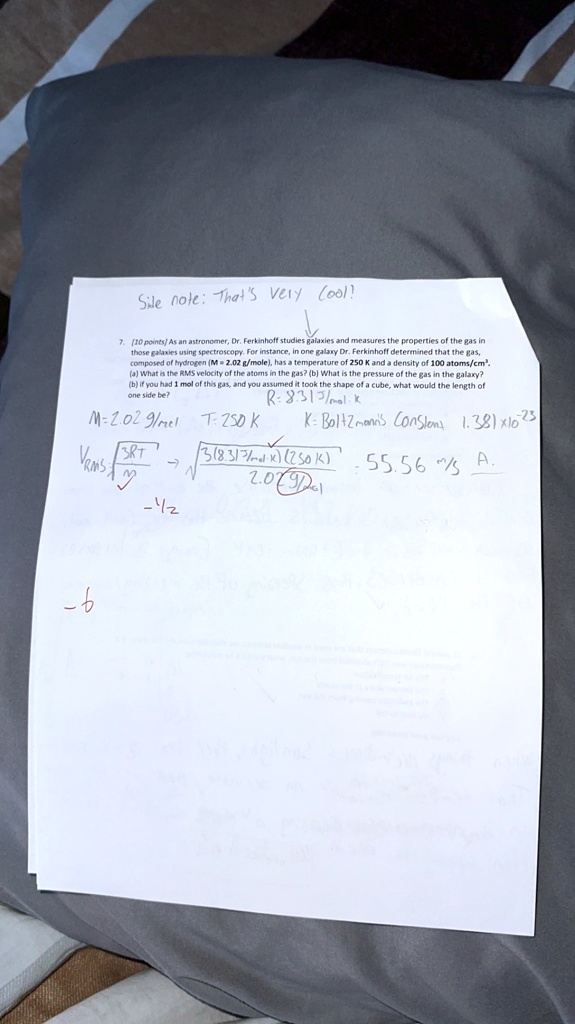
(10 points) As an astronomer, Dr. Ferkinhoff studies galaxies and measures the properties of the gas in those galaxies using spectroscopy. For instance, in one galaxy Dr. Ferkinhoff determined that the gas, composed of hydrogen (M = 2.02 g/mole), has a temperature of 250 K and a density of 100 atoms/cm$^3$. (a) What is the RMS velocity of the atoms in the gas? (b) What is the pressure of the gas in the galaxy? (b) if you had 1 mol of this gas, and you assumed it took the shape of a cube, what would the length of one side be? \~\~\~M=2.02 g/mol \~\~\~T=250 K \~\~\~R=8.31 J/mol \cdot K \~\~\~K=Boltzmann's Constant = 1.381 \times 10^{-23} \~\~\~v_{RMS} = \sqrt{\frac{3RT}{M}} \implies \sqrt{\frac{3(8.31 J/mol \cdot K)(250 K)}{2.02 g/mol}} = 55.56 m/s \~\~\~A.