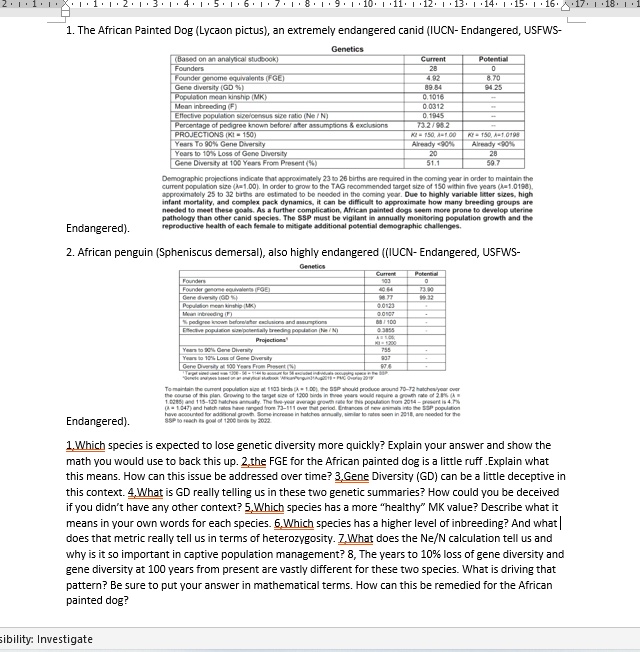
1. The African Painted Dog (Lycaon pictus), an extremely endangered canid (IUCN- Endangered, USFWS- Endangered).
Genetics
(Based on an analytical studbook) Current Potential
Founders 28 0
Founder genome equivalents (FGE) 4.92 8.70
Gene diversity (GD %) 89.84 94.25
Population mean kinship (MK) 0.1016 --
Mean inbreeding (F) 0.0312 --
Effective population size/census size ratio (Ne / N) 0.1945 --
Percentage of pedigree known before/ after assumptions & exclusions 73.2 / 98.2 --
PROJECTIONS (Kt = 150) Kt = 150, ?=1.00 Kt = 150, ?=1.0198
Years To 90% Gene Diversity Already <90% Already <90%
Years to 10% Loss of Gene Diversity 20 28
Gene Diversity at 100 Years From Present (%) 51.1 59.7
Demographic projections indicate that approximately 23 to 26 births are required in the coming year in order to maintain the current population size (?=1.00). In order to grow to the TAG recommended target size of 150 within five years (?=1.0198), approximately 25 to 32 births are estimated to be needed in the coming year. Due to highly variable litter sizes, high infant mortality, and complex pack dynamics, it can be difficult to approximate how many breeding groups are needed to meet these goals. As a further complication, African painted dogs seem more prone to develop uterine pathology than other canid species. The SSP must be vigilant in annually monitoring population growth and the reproductive health of each female to mitigate additional potential demographic challenges.
2. African penguin (Spheniscus demersal), also highly endangered ((IUCN- Endangered, USFWS- Endangered).
Genetics
Current Potential
Founders 103 0
Founder genome equivalents (FGE) 40.64 73.90
Gene diversity (GD %) 98.77 99.32
Population mean kinship (MK) 0.0123 -
Mean inbreeding (F) 0.0107 -
% pedigree known before/after exclusions and assumptions 88 / 100 -
Effective population size/potentially breeding population (Ne / N) 0.3855 -
Projections ? = 1.00; Kt = 1200 -
Years to 90% Gene Diversity 755 -
Years to 10% Loss of Gene Diversity 937 -
Gene Diversity at 100 Years From Present (%) 97.6 -
To maintain the current population size at 1103 birds (? = 1.00), the SSP should produce around 70–72 hatches/year over the course of this plan. Growing to the target size of 1200 birds in three years would require a growth rate of 2.8% (? = 1.0285) and 115–120 hatches annually. The five-year average growth rate for this population from 2014 – present is 4.7% (? = 1.047) and hatch rates have ranged from 73–111 over that period. Entrances of new animals into the SSP population have accounted for additional growth. Some increase in hatches annually, similar to rates seen in 2018, are needed for the SSP to reach its goal of 1200 birds by 2022.
1, Which species is expected to lose genetic diversity more quickly? Explain your answer and show the math you would use to back this up. 2, the FGE for the African painted dog is a little ruff. Explain what this means. How can this issue be addressed over time? 3, Gene Diversity (GD) can be a little deceptive in this context. 4, What is GD really telling us in these two genetic summaries? How could you be deceived if you didn't have any other context? 5, Which species has a more ‘healthy’ MK value? Describe what it means in your own words for each species. 6, Which species has a higher level of inbreeding? And what does that metric really tell us in terms of heterozygosity. 7, What does the Ne/N calculation tell us and why is it so important in captive population management? 8, The years to 10% loss of gene diversity and gene diversity at 100 years from present are vastly different for these two species. What is driving that pattern? Be sure to put your answer in mathematical terms. How can this be remedied for the African painted dog?