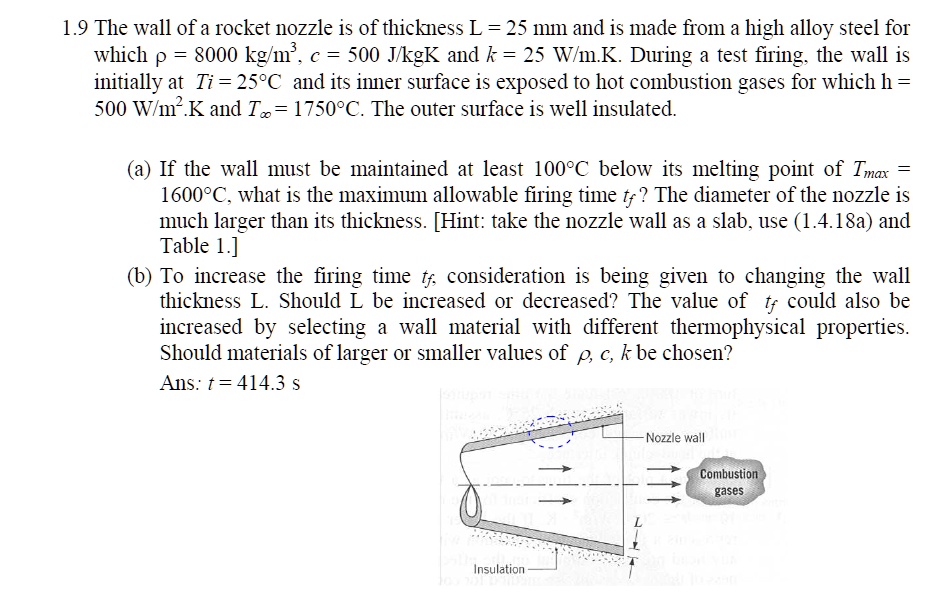
1.9 The wall of a rocket nozzle is of thickness L = 25 mm and is made from a high alloy steel for which $\rho$ = 8000 kg/m$^3$, c = 500 J/kgK and k = 25 W/m.K. During a test firing, the wall is initially at $T_i$ = 25$^\circ$C and its inner surface is exposed to hot combustion gases for which h = 500 W/m$^2$.K and $T_\infty$ = 1750$^\circ$C. The outer surface is well insulated.
(a) If the wall must be maintained at least 100$^\circ$C below its melting point of $T_{max}$ = 1600$^\circ$C, what is the maximum allowable firing time $t_f$? The diameter of the nozzle is much larger than its thickness. [Hint: take the nozzle wall as a slab, use (1.4.18a) and Table 1.]
(b) To increase the firing time $t_f$, consideration is being given to changing the wall thickness L. Should L be increased or decreased? The value of $t_f$ could also be increased by selecting a wall material with different thermophysical properties. Should materials of larger or smaller values of $\rho$, c, k be chosen?
Ans: t = 414.3 s