Ace - AI Tutor
Ask Our Educators
Textbooks
My Library
Flashcards
Scribe - AI Notes
Notes & Exams
Download App
rafael villa

rafael v.

Divider

Questions asked

BEST MATCH

For a saturated solution of lead (II) bromide in pure water with Ksp=4.67 x 10^-6, determine: a) the dissociation equation for lead (II) bromide. b) The Ksp expression for lead (II) bromide. C) the molar solubility of lead (II) bromide.

View Answer
divider
BEST MATCH

describe the type of bonding between silicon atoms in a lattice structure

View Answer
divider
BEST MATCH

is the use of aggregate data to study the behavior of individuals. Ecological inference Unit of analysis Cross-level analysis Ecological fallacy

View Answer
divider
BEST MATCH

Identify three types of synovial joints. Multiple select question. suture plane ball-and-socket condylar gomphosis symphysis

View Answer
divider
BEST MATCH

Choose the correct equilibrium constant expression for the reaction: Zn$^{2+}$ (aq) + 2NH$_3$ (aq) \(\rightleftharpoons\) Zn(NH$_3$)$_2$$^{2+}$ (aq) $K = \frac{[Zn(NH_3)_2^{2+}]}{[Zn^{2+}][NH_3]^2}$ $K = [Zn^{2+}][NH_3][Zn(NH_3)_2^{2+}]$ $K = \frac{[Zn(NH_3)_2^{2+}]}{[Zn^{2+}]}$ $K = \frac{[Zn^{2+}][NH_3]^2}{[Zn(NH_3)]]}$ $K = \frac{[NH_3][Zn(NH_3)_2^{2+}]}{[Zn^{2+}]}$

View Answer
divider
BEST MATCH

Using both the liquidity preference framework and the supply and demand for bonds framework, show why interest rates are procyclical (rising when the economy is expanding and falling during recessions). Using the graph to the right, show the effect on the bond supply and the bond demand curve. Properly label your curves. Indicate the new equilibrium interest rate and quantity of bonds and label it 2. Choose the correct answer below.

View Answer
divider
BEST MATCH

D In the circuit, $R = 245 \Omega$, $C = 54.0 \mu F$, $L = 195 mH$, $f = 76.0 Hz$, and $\epsilon_m = 24.0 V$. What is the phase angle in radians?

View Answer
divider
BEST MATCH

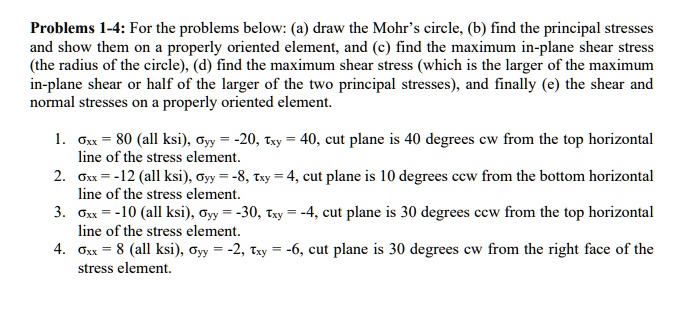
Problems 1-4: For the problems below: (a) draw the Mohr's circle, (b) find the principal stresses and show them on a properly oriented element, and (c) find the maximum in-plane shear stress (the radius of the circle), (d) find the maximum shear stress (which is the larger of the maximum in-plane shear or half of the larger of the two principal stresses), and finally (e) the shear and normal stresses on a properly oriented element. 1. $\sigma_{xx} = 80$ (all ksi), $\sigma_{yy} = -20$, $\tau_{xy} = 40$, cut plane is 40 degrees cw from the top horizontal line of the stress element. 2. $\sigma_{xx} = -12$ (all ksi), $\sigma_{yy} = -8$, $\tau_{xy} = 4$, cut plane is 10 degrees ccw from the bottom horizontal line of the stress element. 3. $\sigma_{xx} = -10$ (all ksi), $\sigma_{yy} = -30$, $\tau_{xy} = -4$, cut plane is 30 degrees ccw from the top horizontal line of the stress element. 4. $\sigma_{xx} = 8$ (all ksi), $\sigma_{yy} = -2$, $\tau_{xy} = -6$, cut plane is 30 degrees cw from the right face of the stress element.
View Answer
divider
BEST MATCH

Question 2 (a) [Personalised using P, where P is 27] A force F has magnitude 70 N and direction \(i + j - 2k\), and a force G has magnitude P N and direction \(5i + 4j - 2k\). Calculate the magnitude of the resultant \(R = F + G\). Give your answer in N, to one decimal place.

View Answer
divider
BEST MATCH

Io j10 ? 15 ? 15?0° A j20 ? -j20 ? +\frac{V_o}{6} + 16I_o 20 ? V_o = -j40 ?

View Answer
divider