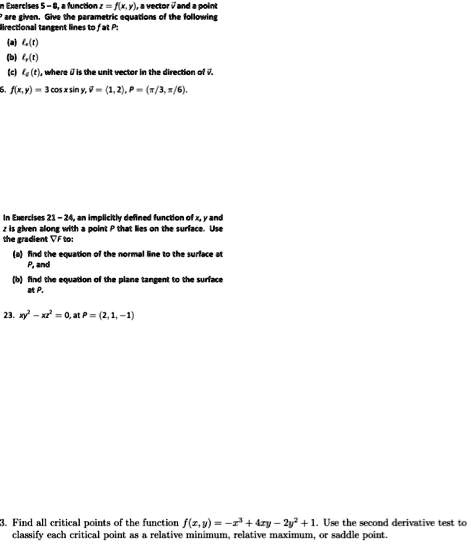
Exercises 5-8, a function $z = f(x, y)$, a vector \vec{v} and a point $P$ are given. Give the parametric equations of the following directional tangent lines to $f$ at $P$:
(a) $\ell_1(t)$
(b) $\ell_2(t)$
(c) $\ell_3(t)$, where \vec{u} is the unit vector in the direction of \vec{v}.
6. $f(x, y) = 3 \cos x \sin y$, $(1, 2)$, $P = (\frac{\pi}{3}, \frac{\pi}{6})$.
In Exercises 21-24, an implicitly defined function of $x$, $y$ and $z$ is given along with a point $P$ that lies on the surface. Use the gradient $\nabla F$ to:
(a) find the equation of the normal line to the surface at $P$, and
(b) find the equation of the plane tangent to the surface at $P$.
23. $xy - xz^2 = 0$, at $P = (2, 1, -1)$
3. Find all critical points of the function $f(x, y) = -x^2 + 4xy - 2y^2 + 1$. Use the second derivative test to classify each critical point as a relative minimum, relative maximum, or saddle point.