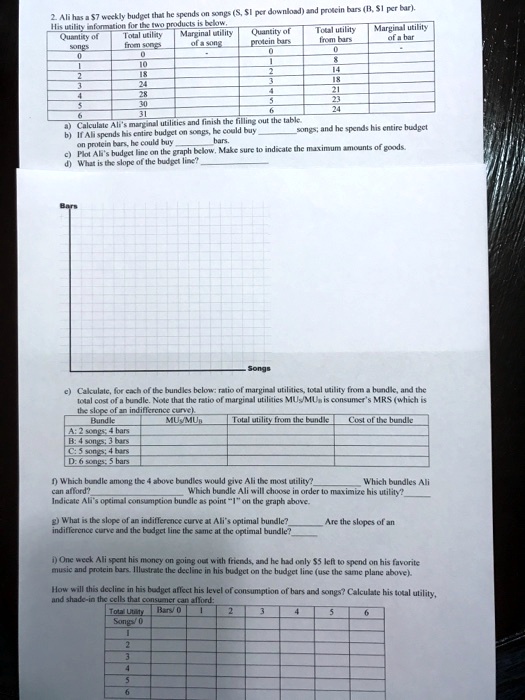
Ali has a $7 weekly budget that he spends on songs (S, $1 per download) and protein bars (B, $1 per bar). His utility information for the two products is below:
Total utility Marginal utility Quantity of bars Total utility Marginal utility Quantity of songs
0 0 10 24 30 31
6
a) If Ali spends his entire budget on songs, he could buy 7 songs.
b) If he spends his entire budget on protein bars, he could buy 7 bars.
c) Plot Ali's budget line on the graph below. Make sure to indicate the maximum amounts of goods.
d) What is the slope of the budget line?
e) Calculate, for each of the bundles below, the ratio of marginal utilities to total utility from a bundle, and the total cost of a bundle. Note that the ratio of marginal utilities (MUs/MUg) is the consumer's MRS (which is the slope of an indifference curve).
Bundle MUs/MUn Total utility from the bundle Cost of the bundle
A: 2 songs; 4 bars
B: 4 songs; 3 bars
C: 5 songs; 4 bars
D: 6 songs; 5 bars
Which bundle among the 4 above bundles would give Ali the most utility? Which bundles can Ali afford? Which bundle will Ali choose in order to maximize his utility? Indicate Ali's optimal consumption bundle as point 1 on the graph above.
g) What is the slope of an indifference curve at Ali's optimal bundle? Are the slopes of an indifference curve and the budget line the same at the optimal bundle?
i) One week, Ali spent his money on going out with friends, and he had only $5 left to spend on his favorite music and protein bars. Illustrate the decline in his budget on the budget line (use the same plane above). How will this decline in his budget affect his level of consumption of bars and songs? Calculate his total utility and shade in the cells that the consumer can afford: Total utility from bars = 0, Total utility from songs = 0.