Clinical Observation \ Feedback
OUTLINECH384_222 Home | Micre
/personal/lamclaughlin944_ad_cfcc_edu/_layouts/15/Doc.aspx?sourcedoc=%783871986F-670D-4287
View Help
Search for tools, help, and more (Option + Q)
BIUAA
less quickly but more effectively by recognizing the foreign agent, creating cellular and
chemical defenses specific for that agent, and establishing a memory of that agent to
prepare the body for a second exposure. Which organs are associated with
adaptive/acquired immunity?
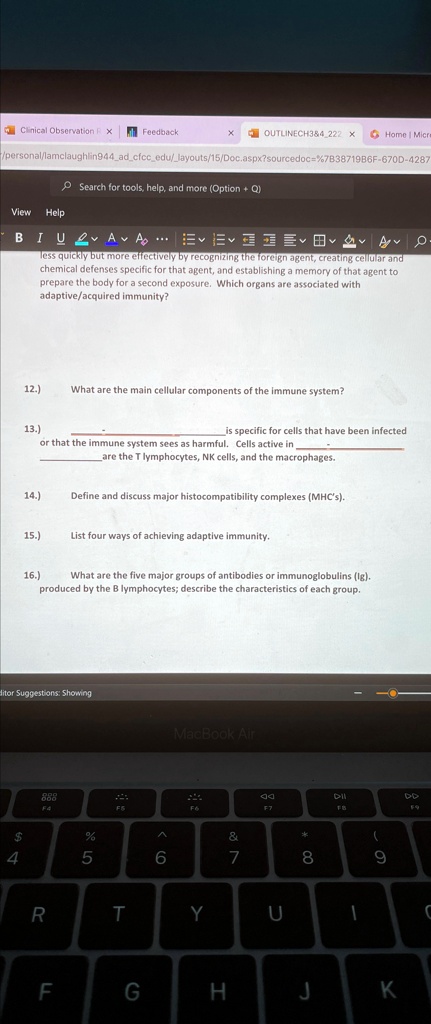
12.) What are the main cellular components of the immune system?
13.)
is specific for cells that have been infected
or that the immune system sees as harmful. Cells active in
are the T lymphocytes, NK cells, and the macrophages.
14.)
Define and discuss major histocompatibility complexes (MHC's).
15.)
List four ways of achieving adaptive immunity.
16.)
What are the five major groups of antibodies or immunoglobulins (Ig).
produced by the B lymphocytes; describe the characteristics of each group.
editor Suggestions: Showing
MacBook Air