Ace - AI Tutor
Ask Our Educators
Textbooks
My Library
Flashcards
Scribe - AI Notes
Notes & Exams
Download App
randall gomez

randall g.

Divider

Questions asked

BEST MATCH

Just as depository institutions differ from non-depository institutions, there are also differences between the structure and activities of, and the financial products and services provided by, various depository institutions. Which of the following statements are true, if any. Check all that apply. The primary business focus of savings and loan associations is collecting funds by accepting deposits and making residential and consumer loans. Demand deposit accounts created by commercial banks are usually called checking accounts or negotiable order of withdrawal (NOW) accounts, while those created by credit unions are called share draft accounts. Commercial banks tend to pay interest rates that are greater than those paid by savings banks and credit unions. Search Grade it Now Save & Continue Continue without saving DELL

View Answer
divider
BEST MATCH

In which way should we look for consciousness in order to study it? As activity changes in the brain networks Using mind wandering as a baseline for consciousness As resulting from activity in a particular structure As changes to the thalamus

View Answer
divider
BEST MATCH

QUESTION 5 When a consumer spends income so that the ratio of marginal utilities (MUs) of all goods purchased equals the ratio of their prices, the consumer is

View Answer
divider
BEST MATCH

Write SQL queries to accomplish each task below using the nyc_airbnb database provided in class. (a) Find the listing that has the most reviews in the last twelve months (number_of_reviews_ltm). The SQL is Blank 1. The price of the listing is Blank 2.

View Answer
divider
BEST MATCH

why surfaces of constant electric potentials are perpendicular to local electric fields line and what the imolications are for ele

View Answer
divider
BEST MATCH

a disk is rotating at 5 rad/s. after 9.3 seconds of uniform angular acceleration, it is rotating at 10 rad/s. how many radians does it turn during this time

View Answer
divider
BEST MATCH

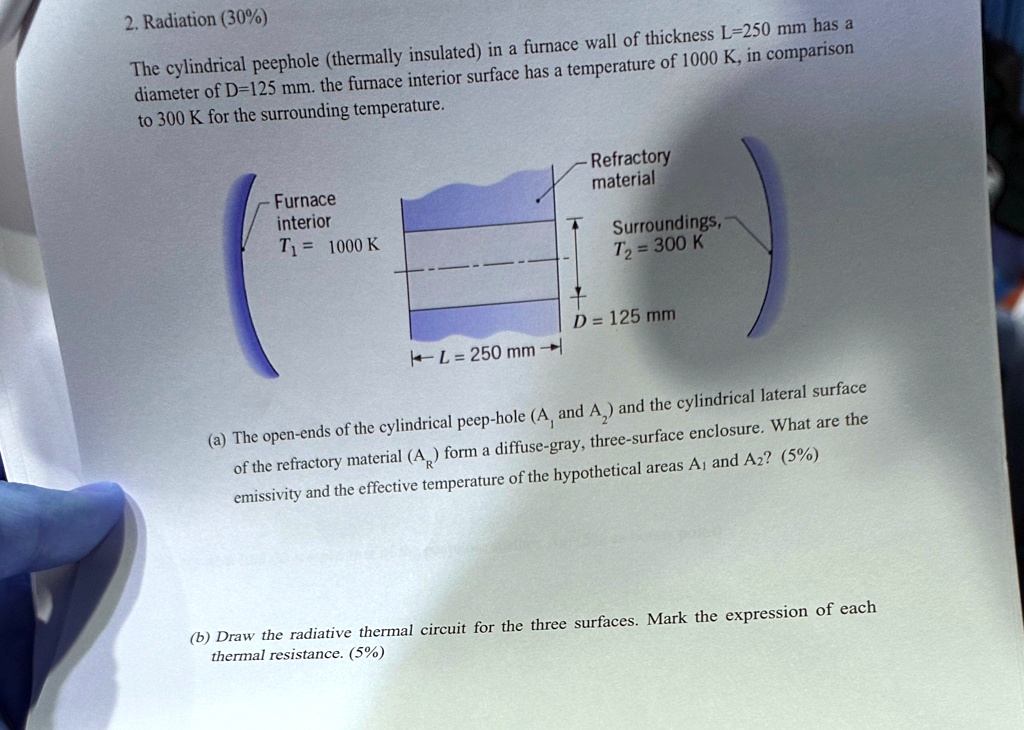
Radiation (30%) The cylindrical peephole (thermally insulated) in a furnace wall of thickness L=250mm has a diameter of D=125mm. the furnace interior surface has a temperature of 1000K, in comparison to 300K for the surrounding temperature. (a) The open-ends of the cylindrical peep-hole and {:A_(2)) and the cylindrical lateral surface of the refractory material (A_(R)) form a diffuse-gray, three-surface enclosure. What are the emissivity and the effective temperature of the hypothetical areas A_(1) and A_(2) ? (5%) (b) Draw the radiative thermal circuit for the three surfaces. Mark the expression of each thermal resistance. (5%) c) find the heat loss through the peephole.you may use table 13.2 in the appendix. d) also find the temperature of thee peephole surface Ar 2.Radiation(30%) diameter of D=125 mm. the furnace interior surface has a temperature of 1000 K, in comparison to 300 K for the surrounding temperature. Refractory material Furnace interior Surroundings, T=1000K T=300K D=125mm L=250mm (a) The open-ends of the cylindrical peep-hole (A, and A,) and the cylindrical lateral surface of the refractory material (A_) form a diffuse-gray, three-surface enclosure. What are the emissivity and the effective temperature of the hypothetical areas A and A? (5%) (b) Draw the radiative thermal circuit for the three surfaces. Mark the expression of each thermal resistance.(5%
View Answer
divider
BEST MATCH

Fill in the areas. 1. Fill in the probabilities for the following Normal Distribution, $\mu = 8.4$ & $\sigma = 4.3$ a. b. 0.768 -0.48 c. 10 d. e. 173 a) \underline{0.0137} \quad 0.01946 b) \underline{0.0111} \quad 0.01850 c) \underline{0.5111} \quad 0.60713 d) \underline{0.2813} \quad 0.32587 e) \underline{0.0768} \quad 0.01924 2. Find the interval centered at that has .60 probability. (this refers to #1 above) 8.4

View Answer
divider
BEST MATCH

Suppose that a continuous-time sinusoid x(t) is sampled at a rate of 500 samples/sec, resulting in the following discrete-time signal: $x[n] = 8 \cos \left(\frac{4\pi}{5}n + \frac{\pi}{6}\right)$ Knowing x[n] does not uniquely determine x(t); there are many continuous-time sinusoidal signals x(t) that when sampled would produce this x[n]. Name three that have a frequency less than 800 Hz. In other words, specify three different continuous-time sinusoidal signals $x_1(t) = A_1 \cos(2\pi f_1 t + \phi_1)$, $x_2(t) = A_2 \cos(2\pi f_2 t + \phi_2)$, and $x_3(t) = A_3 \cos(2\pi f_3 t + \phi_3)$ that could have produced this particular x[n], subject to the constraint that $0 < f_i < 800$ Hz in all cases.

View Answer
divider
BEST MATCH

The area of the region enclosed by the inner loop of $r = 1 - \sqrt{2} \sin(\theta)$ is $\frac{\pi - 3}{2}$ $\frac{\pi + 1}{4}$ $\frac{\pi + 5}{\pi}$ $\frac{\pi + 7}{6}$ $\frac{3\pi + 10}{6}$

View Answer
divider