Please show me how can I do this & if you want to share this solved file, you can comment.
Please answer Question 2 & 4. Show me on the paper.
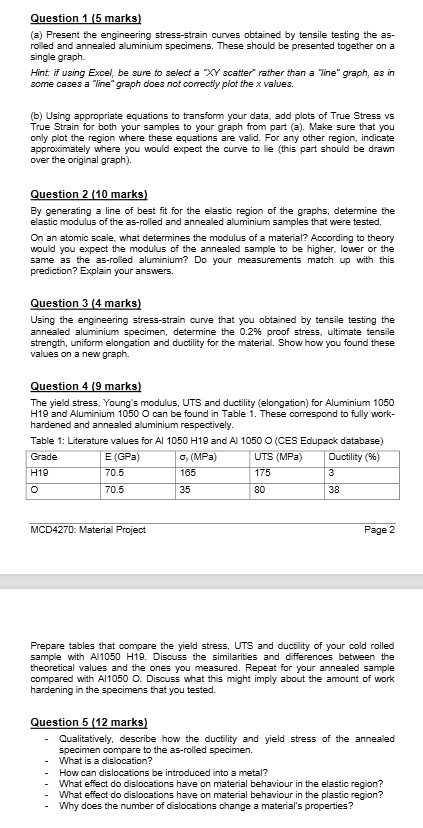
Question 1 (5 marks)
(a) Present the engineering stress-strain curves obtained by tensile testing the as-rolled and annealed aluminium samples on a single graph. Hint: if using Excel, be sure to select an XY scatter rather than a line graph, as in some cases a line graph does not correctly plot the x values.
(b) Using appropriate equations to transform your data, add plots of True Stress vs True Strain approximately where you would expect the curve to lie (this part should be drawn over the original graph).
Question 2 (10 marks)
By generating a line of best fit for the elastic region of the graphs, determine the elastic modulus of the as-rolled and annealed aluminium samples that were tested. On an atomic scale, what determines the modulus of a material? According to theory, would you expect the modulus of the annealed sample to be higher, lower, or the same as the as-rolled aluminium? Do your measurements match up with this prediction? Explain your answers.
Question 3 (4 marks)
Using the engineering stress-strain curve that you obtained by tensile testing the annealed aluminium specimen, determine the 0.2% proof stress, ultimate tensile strength, uniform elongation, and ductility for the material. Show how you found these values on a new graph.
Question 4 (9 marks)
The yield stress, Young's modulus, UTS, and ductility (elongation) for Aluminium 1050 H19 and Aluminium 1050 O can be found in Table 1. These correspond to fully work-hardened and annealed aluminium, respectively.
Table 1: Literature values for AI 1050 H19 and AI 1050 O (CES Edupack database)
Grade E (GPa) y (MPa) UTS (MPa) Ductility (%)
H19 70.5 165 175 70.5
O 35 80 38
Prepare tables that compare the yield stress, UTS, and ductility of your cold-rolled sample with AI1050 H19. Discuss the similarities and differences between the compared with AI1050 O. Discuss what this might imply about the amount of work hardening in the specimens that you tested.
Question 5 (12 marks)
Qualitatively, describe how the ductility and yield stress of the annealed specimen compare to the as-rolled specimen. What is a dislocation? How can dislocations be introduced into a metal? What effect do dislocations have on material behavior in the elastic region? What effect do dislocations have on material behavior in the plastic region? Why does the number of dislocations change a material's properties?