Ace - AI Tutor
Ask Our Educators
Textbooks
My Library
Flashcards
Scribe - AI Notes
Notes & Exams
Download App
randy dalton

randy d.

Divider

Questions asked

BEST MATCH

Calculate \int_C -x^(2)ydx+xy^(2)dy, where C is a circle of radius 2 centered at the origin and oriented in the counterclockwise direction.

View Answer
divider
BEST MATCH

Assume a company’s estimated sales for January, February, and March are 30,000 units, 31,000 units, and 29,000 units, respectively. The company always maintains ending finished goods inventory equal to 30% of next month’s unit sales. What is the required production in units for January? Multiple Choice 30,700 units 29,700 units 30,300 units 39,300 units

View Answer
divider
BEST MATCH

Which of the following does NOT have a layer of smooth muscle? O arteries O veins O arterioles O capillaries

View Answer
divider
BEST MATCH

I've seen different answers and would like an expert opinion please and thanks! The next twelve questions are about this circuit. The voltage of the battery is 12 V, and the values of the resistances are: R1 = 5 ohms, R2 = 10 ohms, R3 = 15 ohms, and R4 = 20 ohms. 1) R1 and R3 are in: parallel or series or neither 2) R2 and R4 are in: parallel series neither 3) Compare the magnitude of the current through R2 and R3 I2 > I3 I2 = I3 I2 < I3 4) Compare the magnitude of the voltage across R1 and R3 V1 > V3 V1 = V3 V1 < V3 5) Compare the magnitude of the voltage across R2 and R4 V2 > V4 V2 = V4 V2 < V4 6) Compare the magnitude of the current through R1 and R4 I1 > I4 I1 = I4 I1 < I4 7) Calculate the total equivalent resistance of this circuit. 2.11 ohms 4.06 ohms 8.73 ohms 24.9 ohms 50.0 ohms 8) Calculate the current going through R1. 0.34 A 0.57 A 1.58 A 2.40 A 2.74 A 9) Calculate the current going through R2. 0.37 A 0.57 A 1.58 A 2.40 A 2.74 A 10) Calculate the voltage drop across R3. 3.4 V 5.7 V 8.3 V 10.2 V 12 V 11) Calculate the voltage drop across R4. 3.7 V 5.7 V 8.6 V 10.2 V 12 V 12) Calculate the total power dissipated in this circuit. 12 W 24 W 35 W 48 W 60 W

View Answer
divider
BEST MATCH

What are the four forms of law that comprise the majority of the legal systems in the world? Name one country for each system.

View Answer
divider
BEST MATCH

Market price for memory modules: $ Number of units to manufacture: thousand How would your report change if the price of desktops were $1,080? Market price for memory modules: $ Number of units to manufacture: thousand What does this indicate about the relationship between memory modules and desktop systems? They are neither complements nor substitutes. They are substitutes. They are complements.

View Answer
divider
BEST MATCH

a kangaroo can jump over an object 1.68 m high. calculate how long in seconds it is in the air.

View Answer
divider
BEST MATCH

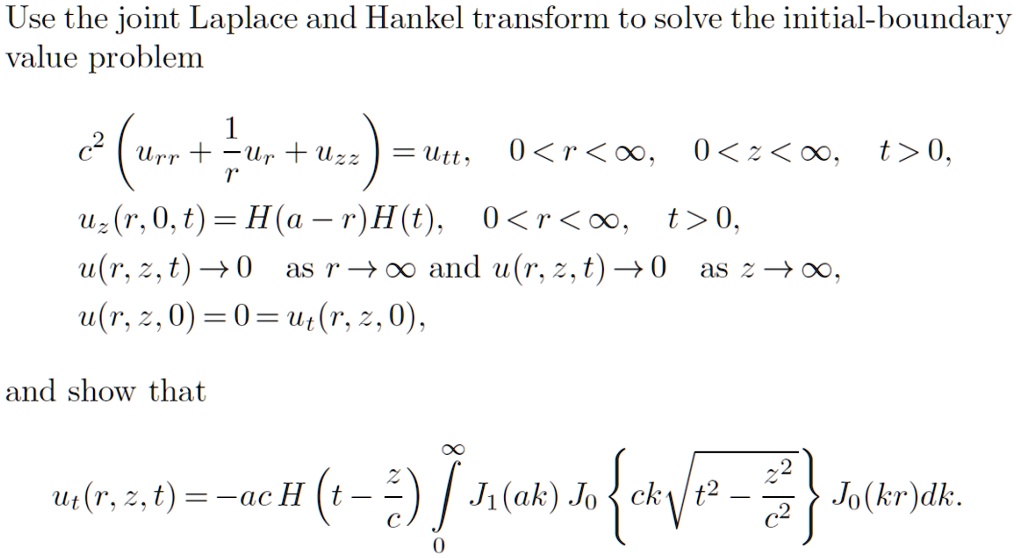
Use the joint Laplace and Hankel transform to solve the initial-boundary value problem $\qquad c^2 \left( u_{rr} + \frac{1}{r} u_r + u_{zz} \right) = u_{tt}, \qquad 0 < r < \infty, \quad 0 < z < \infty, \quad t > 0$, $\qquad u_z(r, 0, t) = H(a - r)H(t), \qquad 0 < r < \infty, \quad t > 0$, $\qquad u(r, z, t) \to 0 \quad \text{as} \quad r \to \infty \quad \text{and} \quad u(r, z, t) \to 0 \quad \text{as} \quad z \to \infty$, $\qquad u(r, z, 0) = 0 = u_t(r, z, 0)$, and show that $\qquad u_t(r, z, t) = -acH \left( t - \frac{z}{c} \right) \int_0^\infty J_1(ak) J_0 \left\{ ck\sqrt{t^2 - \frac{z^2}{c^2}} \right\} J_0(kr) dk.$
View Answer
divider
BEST MATCH

In their critique of the James-Lange theory, Cannon and Bard argued that... A. People are slow to subjectively experience emotions, relative to how quickly their bodies respond physiologically. B. Physiological feedback to the brain is necessary in order for someone to subjectively experience an emotion. C. Physiological evidence shows general arousal, not emotion-specific responses. D. All of the above

View Answer
divider
BEST MATCH

Solve for $I_1, I_2, I_3$ using Gauss elimination (either by hand or MATLAB). Also, show the REF of the system. 4. Kirchhoff's voltage law says that the sum of the voltage drops around any closed path in the network in a given direction is zero. When this principle is applied to the circuit shown in Figure 3.5, we obtain the following linear system of equations: $(R_1 + R_3 + R_4)I_1 +$ $R_3I_2 +$ $R_4I_3 = E_1$ $R_3I_1 + (R_2 + R_3 + R_5)I_2 -$ $R_5I_3 = E_2$ $R_4I_1 -$ $R_5I_2 + (R_4 + R_5 + R_6)I_3 = 0.$ (c) $R_1 = 1, R_2 = 2, R_3 = 4, R_4 = 3, R_5 = 1, R_6 = 5,$ and $E_1 = 41, E_2 = 38$

View Answer
divider