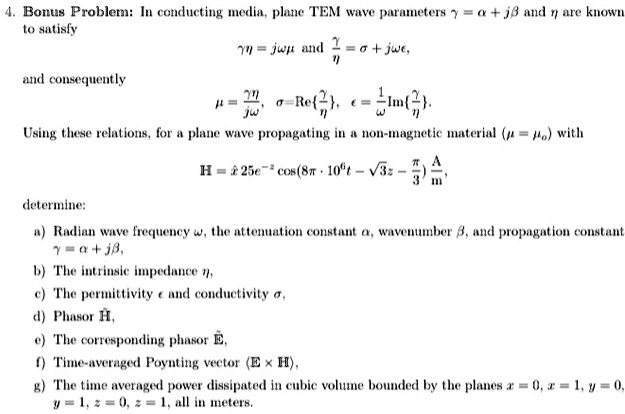
4. Bonus Problem: In conducting media, plane TEM wave parameters \(\gamma = \alpha + j\beta\) and \(\eta\) are known to satisfy
\(\gamma \eta = j\omega \mu\) and \(\frac{\gamma}{\eta} = \sigma + j\omega \epsilon\),
and consequently
\(\mu = \frac{2\gamma}{j\omega}, \quad \sigma = Re\{\frac{\gamma}{\eta}\}, \quad \epsilon = \frac{1}{\omega} Im\{\frac{\gamma}{\eta}\}\).
Using these relations, for a plane wave propagating in a non-magnetic material \(\mu = \mu_0\) with
\(\mathbf{H} = \hat{x} 25e^{-z} \cos(8\pi \cdot 10^6 t - \sqrt{3}z - \frac{\pi}{3}) \frac{A}{m}\)
determine:
a) Radian wave frequency \(\omega\), the attenuation constant \(\alpha\), wavenumber \(\beta\), and propagation constant \(\gamma = \alpha + j\beta\),
b) The intrinsic impedance \(\eta\),
c) The permittivity \(\epsilon\) and conductivity \(\sigma\),
d) Phasor \(\mathbf{H}\),
e) The corresponding phasor \(\mathbf{E}\),
f) Time-averaged Poynting vector \(\langle \mathbf{E} \times \mathbf{H} \rangle\),
g) The time averaged power dissipated in cubic volume bounded by the planes \(x = 0\), \(x = 1\), \(y = 0\), \(y = 1\), \(z = 0\), \(z = 1\), all in meters.