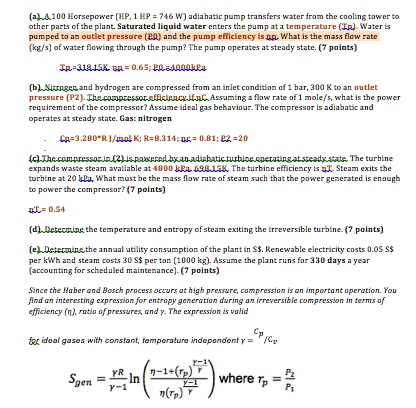
(a) 100 Horsepower (HP, 1 HP = 746 W) adiabatic pump transfers water from the cooling tower to other parts of the plant. Saturated liquid water enters the pump at a temperature (Tp). Water is pumped to an outlet pressure (PQ) and the pump efficiency is up. What is the mass flow rate (kg/s) of water flowing through the pump? The pump operates at steady state. (7 points)
Tp = 318.15 K; R = 0.65; P0 = 64000 kPa
(b) Nitrogen and hydrogen are compressed from an inlet condition of 1 bar, 300 K to an outlet pressure (P2). The compressor is adiabatic and operates at steady state. Assuming a flow rate of 1 mole/s, what is the power requirement of the compressor? Assume ideal gas behavior.
Gas: nitrogen
Cp = 3.280 * R J/molK; R = 8.314; γ = 0.81; P2 = 20
(c) The compressor in (b) is powered by an adiabatic turbine operating at steady state. The turbine expands waste steam available at 4800 kPa, 698.15 K. The turbine efficiency is . Steam exits the turbine at 20 kPa. What must be the mass flow rate of steam such that the power generated is enough to power the compressor? (7 points)
T = 0.54
(d) Determine the temperature and entropy of steam exiting the irreversible turbine. (7 points)
(e) Determine the annual utility consumption of the plant in S$. Renewable electricity costs 0.05 S$ per kWh and steam costs 30 S$ per ton (1000 kg). Assume the plant runs for 330 days a year (accounting for scheduled maintenance). (7 points)
Since the Haber and Bosch process occurs at high pressure, compression is an important operation. You find an interesting expression for entropy generation during an irreversible compression in terms of efficiency (n), ratio of pressures, and γ. The expression is valid for ideal gases with constant temperature and independent γ = YRn-1+(rp)γ In γ-1 n(rp)γ
Sgen
P1