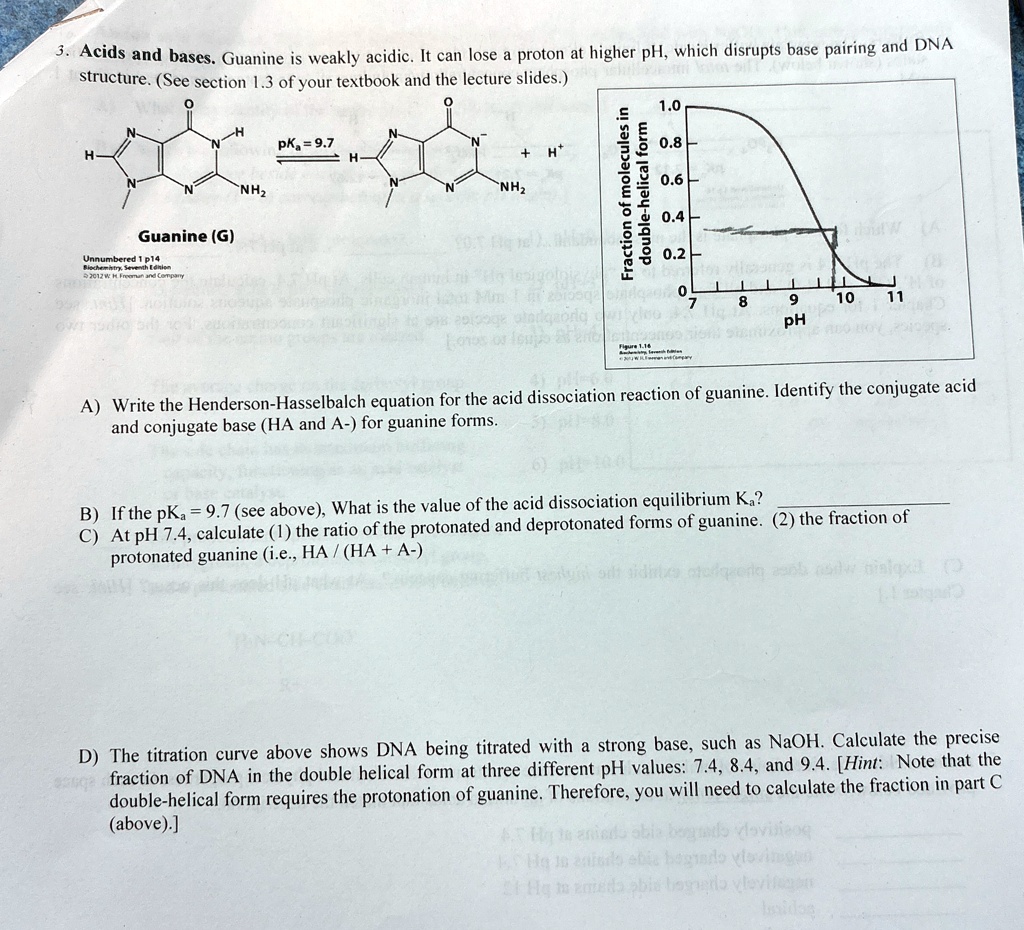
3. Acids and bases. Guanine is weakly acidic. It can lose a proton at higher pH, which disrupts base pairing and DNA structure. (See section 1.3 of your textbook and the lecture slides.)
$pK_a = 9.7$
A) Write the Henderson-Hasselbalch equation for the acid dissociation reaction of guanine. Identify the conjugate acid and conjugate base (HA and A-) for guanine forms.
B) If the $pK_a = 9.7$ (see above), What is the value of the acid dissociation equilibrium $K_a$?
C) At pH 7.4, calculate (1) the ratio of the protonated and deprotonated forms of guanine. (2) the fraction of protonated guanine (i.e., HA / (HA + A-)
D) The titration curve above shows DNA being titrated with a strong base, such as NaOH. Calculate the precise fraction of DNA in the double helical form at three different pH values: 7.4, 8.4, and 9.4. [Hint: Note that the double-helical form requires the protonation of guanine. Therefore, you will need to calculate the fraction in part C (above).]