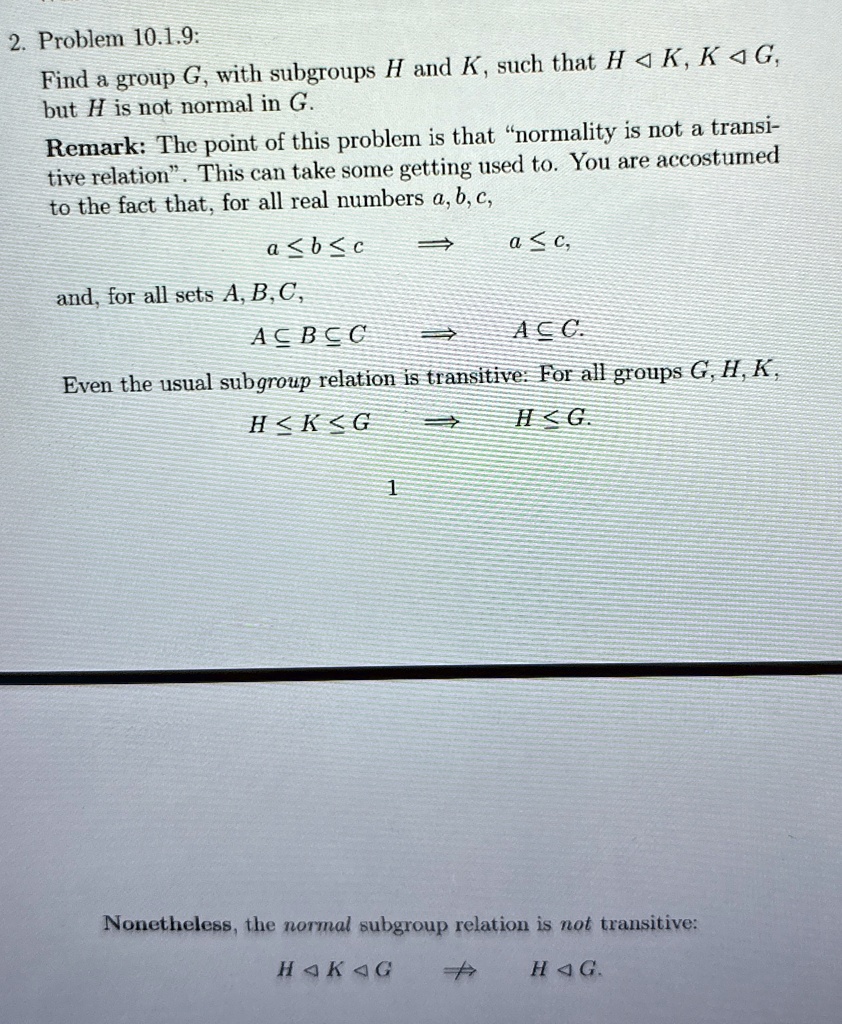
2. Problem 10.1.9:
Find a group G, with subgroups H and K, such that $H \triangleleft K$, $K \triangleleft G$,
but H is not normal in G.
Remark: The point of this problem is that “normality is not a transitive relation”. This can take some getting used to. You are accustomed
to the fact that, for all real numbers $a, b, c$,
$a < b < c \implies a < c$,
and, for all sets A, B, C,
$A \subset B \subset C \implies A \subset C$.
Even the usual subgroup relation is transitive: For all groups G, H, K,
$H < K < G \implies H < G$.
Nonetheless, the normal subgroup relation is not transitive:
$H \triangleleft K \triangleleft G \implies H \triangleleft G$.