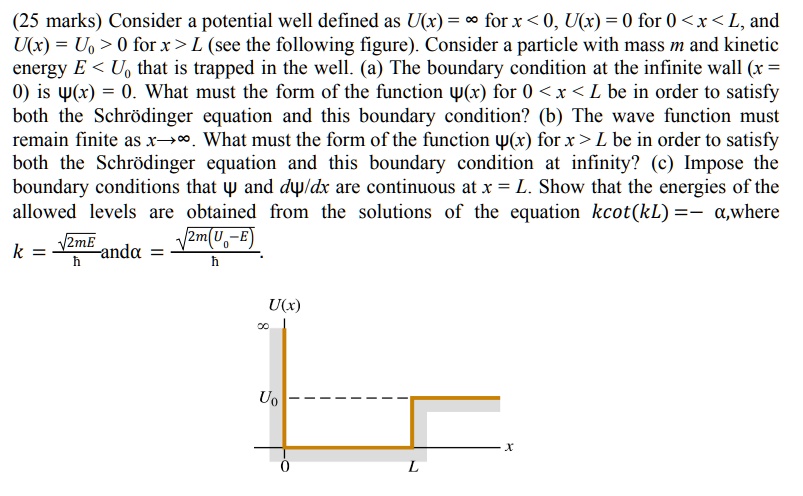
(25 marks) Consider a potential well defined as $U(x) = \infty$ for $x < 0$, $U(x) = 0$ for $0 < x < L$, and $U(x) = U_0 > 0$ for $x > L$ (see the following figure). Consider a particle with mass $m$ and kinetic energy $E < U_0$ that is trapped in the well. (a) The boundary condition at the infinite wall ($x = 0$) is $\psi(x) = 0$. What must the form of the function $\psi(x)$ for $0 < x < L$ be in order to satisfy both the Schrödinger equation and this boundary condition? (b) The wave function must remain finite as $x \to \infty$. What must the form of the function $\psi(x)$ for $x > L$ be in order to satisfy both the Schrödinger equation and this boundary condition at infinity? (c) Impose the boundary conditions that $\psi$ and $d\psi/dx$ are continuous at $x = L$. Show that the energies of the allowed levels are obtained from the solutions of the equation $kcot(kL) = -\alpha$, where $k = \frac{\sqrt{2mE}}{\hbar}$ and $\alpha = \frac{\sqrt{2m(U_0 - E)}}{\hbar}$.