Ace - AI Tutor
Ask Our Educators
Textbooks
My Library
Flashcards
Scribe - AI Notes
Notes & Exams
Download App
rebecca carpenter

rebecca c.

Divider

Questions asked

BEST MATCH

Qz3 Score: 3.6/10 Answered: 2/5 Question 3 Solve the system of equations x - 4 = 2z - y 4x = y + 4z Enter your solution in parameterized form, using \textit{t} to parameterize the free variable. x = y = z = Check All Parts

View Answer
divider
BEST MATCH

Part A Role of FSH in male reproductive physiology stimulates production and release of FSH and LH by the anterior pituitary causes sustentacular cells to release androgen binding protein stimulates testosterone production by interstitial cells of the testis decreases release of hormone by the hypothalamus

View Answer
divider
BEST MATCH

Name: q, Section: q, Table 3.2 able[[ able[[Culture],[Conditions]], able[[Rxn],[# Name: Section: Table 3.2 Tube 1 Fresh TSB Lysis E.coli Z buffer to Vol.ONPG for Reagent volume bring to 1 mL (4 mg/mL) for 0.8 differences in from total mg enzyme vol. Tube 2 Culture Conditions Rxn # No sugars E.coli culture +20% Lactose 1 40 L 5L 10L 745L Glucose E.coli culture +20% Lactose 2 40L 5L 10L No sugars E.coli culture + 20% Glucose 40L 5uL 10L 3 Lactose E.coli culture +20%Glucose 5 L 10L 4 40L BLANK

View Answer
divider
BEST MATCH

Write \frac{\sin x}{1 + \sin x} in terms of half- angle. a. \frac{2 \tan(\frac{x}{2})}{(1 + \tan(\frac{x}{2}))^2} b. \frac{2 \tan(\frac{x}{2})}{\sec^2(\frac{x}{2})} c. 2 \sin(x/2) d. \cos(\frac{x}{2})

View Answer
divider
BEST MATCH

what diseases would occur if protein serine/ threonine kinase was mutated

View Answer
divider
BEST MATCH

The nucleus is to eukaryotes as the ____ is to prokaryotes. Multiple Choice plasmid RNA strand ribosome nucleoid nucleolus

View Answer
divider
BEST MATCH

Biotic, abiotic, and climatic characteristics define a(n) population biome community organism

View Answer
divider
BEST MATCH

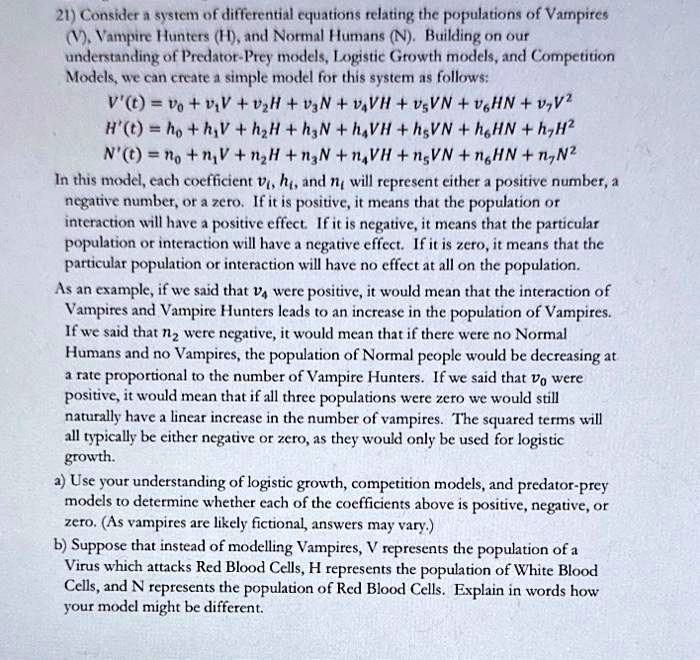
Texts: 21. Consider a system of differential equations relating the populations of Vampires (V), Vampire Hunters (H), and Normal Humans (N). Building on our understanding of Predator-Prey models, Logistic Growth models, and Competition Models, we can create a simple model for this system as follows: V(t) = Vo + vV + vH + vN + vVH + vsVN + v6HN + vV^2 H(t) = ho + hV + hH + hN + hVH + hsVN + hHN + hH^2 N(t) = no + nV + nH + nN + nVH + nVN + nHN + nN In this model, each coefficient v, h, and n will represent either a positive number, a negative number, or a zero. If it is positive, it means that the population or interaction will have a positive effect. If it is negative, it means that the particular population or interaction will have a negative effect. If it is zero, it means that the particular population or interaction will have no effect at all on the population. As an example, if we said that v were positive, it would mean that the interaction of Vampires and Vampire Hunters leads to an increase in the population of Vampires. If we said that n were negative, it would mean that if there were no Normal Humans and no Vampires, the population of Normal people would be decreasing at a rate proportional to the number of Vampire Hunters. If we said that Vo were positive, it would mean that if all three populations were zero, we would still naturally have a linear increase in the number of vampires. The squared terms will all typically be either negative or zero, as they would only be used for logistic growth. a) Use your understanding of logistic growth, competition models, and predator-prey models to determine whether each of the coefficients above is positive, negative, or zero. (As vampires are likely fictional, answers may vary.) b) Suppose that instead of modeling Vampires, V represents the population of a Virus which attacks Red Blood Cells, H represents the population of White Blood Cells, and N represents the population of Red Blood Cells. Explain in words how your model might be different.
View Answer
divider
BEST MATCH

Which of the following is correct for a single-price monopoly? i. The firm can determine the quantity it produces and the price it charges. ii. It would never profitably produce output in the inelastic range of its demand. iii. Its marginal revenue is less than price. A) ii and iii B) i and iii C) ii only D) i only E) i, ii, and iii

View Answer
divider
BEST MATCH

Problem 2. (20pts) Two particles moving with constant velocity are described by the position vectors: \textbf{p} = \textbf{p}_0 + \textbf{v}t, \textbf{s} = \textbf{s}_0 + \textbf{w}t a) Show that the shortest distance between their trajectories is given by $d = \frac{| (\textbf{s}_0 - \textbf{p}_0) \cdot (\textbf{w} \times \textbf{v}) |}{|\textbf{w} \times \textbf{v}|}$ b) Find the shortest distance between the particles themselves.

View Answer
divider