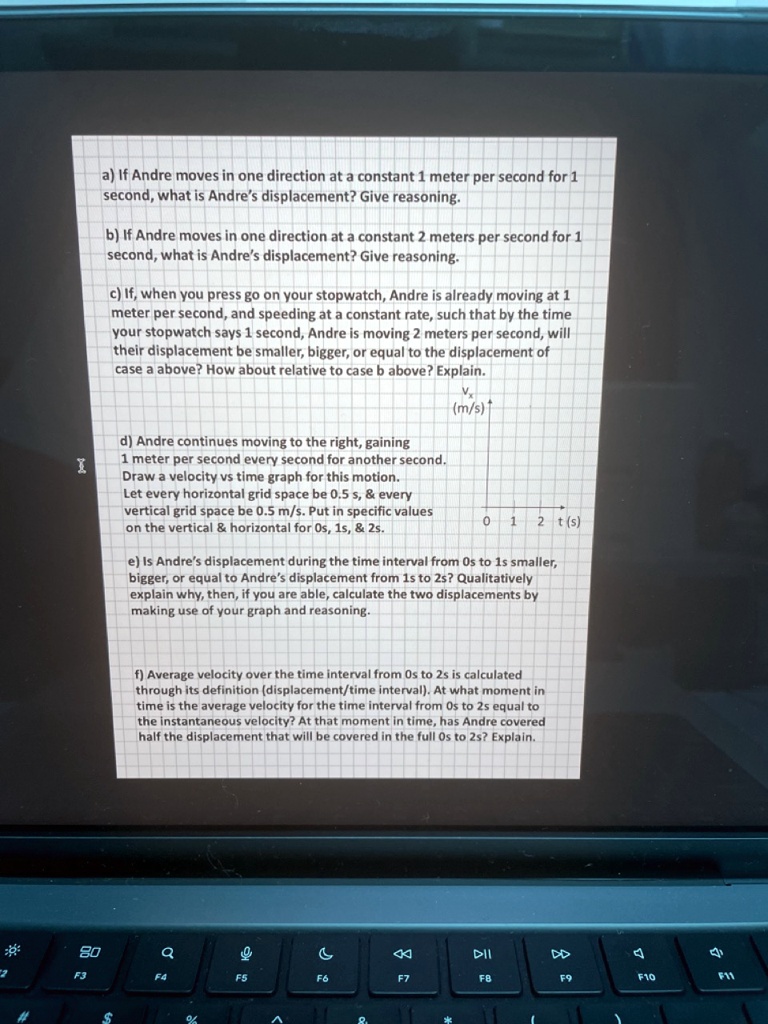
a) If Andre moves in one direction at a constant 1 meter per second for 1 second, what is Andre's displacement? Give reasoning.
b) If Andre moves in one direction at a constant 2 meters per second for 1 second, what is Andre's displacement? Give reasoning.
c) If, when you press go on your stopwatch, Andre is already moving at 1 meter per second, and speeding at a constant rate, such that by the time your stopwatch says 1 second, Andre is moving 2 meters per second, will their displacement be smaller, bigger, or equal to the displacement of case a above? How about relative to case b above? Explain.
d) Andre continues moving to the right, gaining 1 meter per second every second for another second. Draw a velocity vs time graph for this motion. Let every horizontal grid space be 0.5 s, and every vertical grid space be 0.5 m/s. Put in specific values on the vertical and horizontal for 0s, 1s, and 2s.
e) Is Andre's displacement during the time interval from 0s to 1s smaller, bigger, or equal to Andre's displacement from 1s to 2s? Qualitatively explain why, then, if you can, calculate the two displacements by using your graph and reasoning.
f) Average velocity over the time interval from 0s to 2s is calculated through its definition (displacement/time interval). At what moment in time is the average velocity for the time interval from 0s to 2s equal to the instantaneous velocity? At that moment in time, has Andre covered half the displacement that will be covered in the full 0s to 2s? Explain.