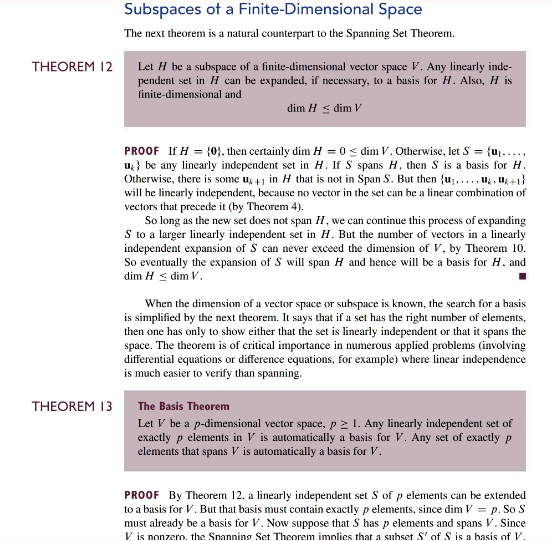
*When the dimension of a vector space is known, what is an effective way to determine if a set of vector is a basis for that vector space? (Hint: read Theorem 13). Why do you think linear independence is easier to verify than spanning?
Subspaces of a Finite-Dimensional Space
The next theorem is a natural counterpart to the Spanning Set Theorem.
THEOREM 12
Let H be a subspace of a finite-dimensional vector space V. Any linearly inde-
pendent set in H can be expanded, if necessary, to a basis for H. Also, H is
finite-dimensional and
dimH<=dimV
PROOF If H={0}, then certainly dimH=0<=dimV. Otherwise, let S={(u_(1)),(dots):},
{:u_(k)} be any linearly independent set in H. If S spans H, then S is a basis for H.
Otherwise, there is some u_(k+1) in H that is not in SpanS. But then {u_(1),dots,u_(k),u_(k+1)}
will be linearly independent, because no vector in the set can be a linear combination of
vectors that precede it (by Theorem 4).
So long as the new set does not span H, we can continue this process of expanding
S to a larger linearly independent set in H. But the number of vectors in a linearly
independent expansion of S can never exceed the dimension of V, by Theorem 10 .
So eventually the expansion of S will span H and hence will be a basis for H, and
dimH<=dimV.
When the dimension of a vector space or subspace is known, the search for a basis
is simplified by the next theorem. It says that if a set has the right number of elements,
then one has only to show either that the set is linearly independent or that it spans the
space. The theorem is of critical importance in numerous applied problems (involving
differential equations or difference equations, for example) where linear independence
is much easier to verify than spanning.
The Basis Theorem
Let V be a p-dimensional vector space, p>=1. Any linearly independent set of
exactly p elements in V is automatically a basis for V. Any set of exactly p
elements that spans V is automatically a basis for V.
PROOF By Theorem 12, a linearly independent set S of p elements can be extended
to a basis for V. But that basis must contain exactly p elements, sincedimV=p. So S
must already be a basis for V. Now suppose that S has p elements and spans V. Since
V is nonzern, the Snanning Set Theorem imnlies that a subset S^(') of S is a basis of V.
Subspaces ot a Finite-Dimensional Space
The next theorem is a natural counterpart to the Spanning Set Theorem.
THEOREM 12
Let H be a subspace of a finite-dimensional vector space V. Any linearly inde- pendent set in H can be expanded, if necessary, to a basis for H. Also, H is finite-dimensional and dim H dim V
PROOFIf H={},then certainly dim H=0dim V.Otherwise,let S={u. u} be any linearly independent set in H. If S spans H, then S is a basis for H. Otherwise, there is some u+1 in H that is not in Span S. But then {u...., , U+1} will be linearly independent, because no vector in the set can be a linear combination of vectors that precede it (by Theorem 4). So long as the new set does not span H, we can continue this process of expanding S to a larger linearly independent set in H. But the number of vectors in a linearly independent expansion of S can never exceed the dimension of V, by Theorem 10. So eventually the expansion of S will span H and hence will be a basis for H, and dim H < dim V. -
When the dimension of a vector space or subspace is known, the search for a basis is simplified by the next theorem. It says that if a set has the right number of elements, then one has only to show either that the set is linearly independent or that it spans the space. The theorem is of critical importance in numerous applied problems (involving differential equations or difference equations, for example) where linear independence is much easier to verify than spanning.
THEOREM 13
The Basis Theorem Let V be a p-dimensional vector space, p 1. Any linearly independent set of exactly p elements in V is automatically a basis for V. Any set of exactly p elements that spans V is automatically a basis for V.
PRO0F By Theorem 12, a linearly independent set S of p elements can be extended to a basis for V. But that basis must contain exactly p elements, since dim V = p. So S must already be a basis for V. Now suppose that S has p elements and spans V. Since