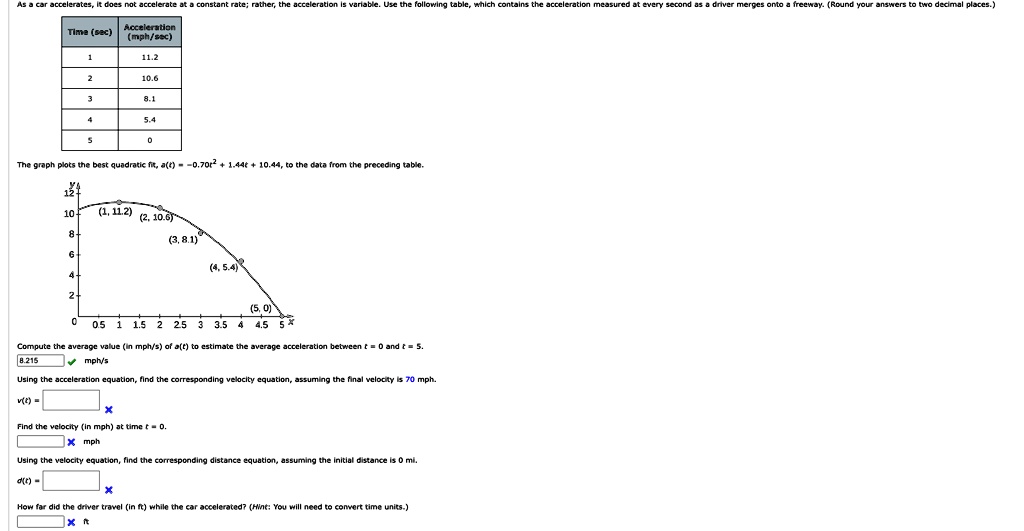
As a car accelerates, it does not accelerate at a constant rate; rather, the acceleration is variable. Use the following table, which contains the acceleration measured at every second as a driver merges onto a freeway. (Round your answers to two decimal places.)
Time (sec)
Acceleration
(mph/sec)
1
11.2
2
10.6
3
8.1
4
5.4
5
0
The graph plots the best quadratic fit, $a(t) = -0.70t^2 + 1.44t + 10.44$, to the data from the preceding table.
Compute the average value (in mph/s) of $a(t)$ to estimate the average acceleration between $t = 0$ and $t = 5$.
8.215
?mph/s
Using the acceleration equation, find the corresponding velocity equation, assuming the final velocity is 70 mph.
v(t) =
x
Find the velocity (in mph) at time $t = 0$.
mph
Using the velocity equation, find the corresponding distance equation, assuming the initial distance is 0 mi.
d(t) =
x
How far did the driver travel (in ft) while the car accelerated? (Hint: You will need to convert time units.)
x ft