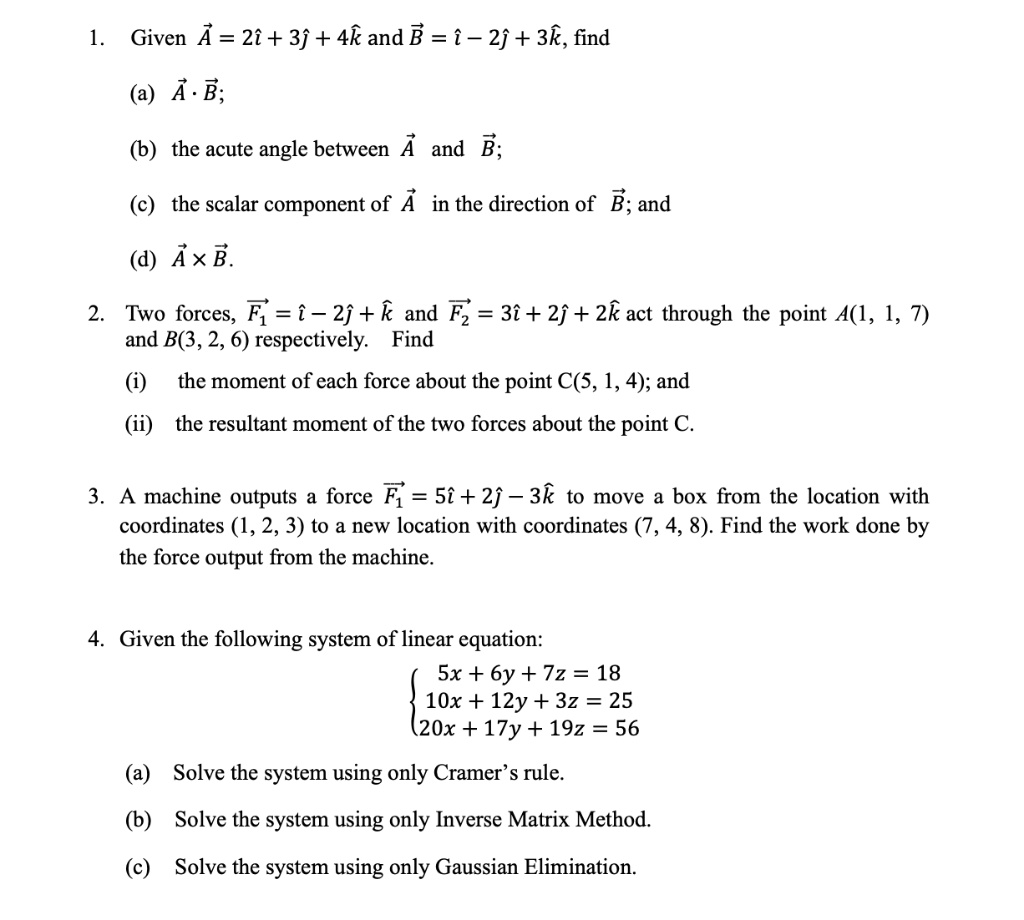
1. Given \(\vec{A} = 2\hat{i} + 3\hat{j} + 4\hat{k}\) and \(\vec{B} = \hat{i} - 2\hat{j} + 3\hat{k}\), find
(a) \(\vec{A} \cdot \vec{B}\);
(b) the acute angle between \(\vec{A}\) and \(\vec{B}\);
(c) the scalar component of \(\vec{A}\) in the direction of \(\vec{B}\); and
(d) \(\vec{A} \times \vec{B}\).
2. Two forces, \(\vec{F_1} = \hat{i} - 2\hat{j} + \hat{k}\) and \(\vec{F_2} = 3\hat{i} + 2\hat{j} + 2\hat{k}\) act through the point A(1, 1, 7)
and B(3, 2, 6) respectively. Find
(i) the moment of each force about the point C(5, 1, 4); and
(ii) the resultant moment of the two forces about the point C.
3. A machine outputs a force \(\vec{F_1} = 5\hat{i} + 2\hat{j} - 3\hat{k}\) to move a box from the location with
coordinates (1, 2, 3) to a new location with coordinates (7, 4, 8). Find the work done by
the force output from the machine.
4. Given the following system of linear equation:
\(\begin{cases}
5x + 6y + 7z = 18 \\
10x + 12y + 3z = 25 \\
20x + 17y + 19z = 56
\end{cases}\)
(a) Solve the system using only Cramer's rule.
(b) Solve the system using only Inverse Matrix Method.
(c) Solve the system using only Gaussian Elimination.