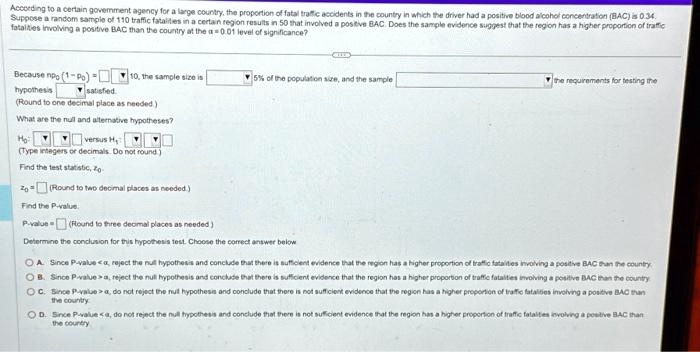
According to a certain government agency for a large country, the proportion of fatal traffic accidents in the country in which the driver had a positive blood alcohol concentration (BAC) is 0.34.
Suppose a random sample of 110 traffic fatalities in a certain region results in 50 that involved a positive BAC. Does the sample evidence suggest that the region has a higher proportion of traffic
fatalities involving a positive BAC than the country at the $\alpha = 0.01$ level of significance?
Because $n p_0 (1 - p_0) \ge 10$, the sample size is$\ge$ 5% of the population size, and the sample$\ge$ the requirements for testing the
hypothesis$\Box$ satisfied.
(Round to one decimal place as needed.)
What are the null and alternative hypotheses?
$H_0: \Box \Box \Box$ versus $H_1: \Box \Box \Box$
(Type integers or decimals. Do not round.)
Find the test statistic, $z_0$
$z_0 = \Box$ (Round to two decimal places as needed.)
Find the P-value.
P-value = $\Box$ (Round to three decimal places as needed)
Determine the conclusion for this hypothesis test. Choose the correct answer below
A. Since P-value $< \alpha$, reject the null hypothesis and conclude that there is sufficient evidence that the region has a higher proportion of traffic fatalities involving a positive BAC than the country
B. Since P-value $> \alpha$, reject the null hypothesis and conclude that there is sufficient evidence that the region has a higher proportion of traffic fatalities involving a positive BAC than the country
C. Since P-value $> \alpha$, do not reject the null hypothesis and conclude that there is not sufficient evidence that the region has a higher proportion of traffic fatalities involving a positive BAC than
the country
D. Since P-value $< \alpha$, do not reject the null hypothesis and conclude that there is not sufficient evidence that the region has a higher proportion of traffic fatalities involving a positive BAC than
the country