Exercise 9.1- Decide whether or not each statement is necessarily true.
1. If X and Y are independent discrete random variables, then $f_{XY}(xy) = f_X(x)$.
2. We repeatedly toss a fair coin. Let U be the number of trials needed to get the first head
and V be the number of trials needed to get two successive heads. Then, U and V are
independent random variables.
3. For a continuous random vector (X,Y) and real numbers a, b, c, d with a < b and c<d,
P((X,Y) ∈ [a,b] x [c,d]) = $F_{XY}(b,d) - F_{X,Y}(a,d) - F_{X,Y}(b,c)+F_{X,Y}(a,c)$.
4. For a continuous random vector (X,Y) and real numbers a, b, c, d with a < b and c <d,
P((X, Y) ∈ [a,b] x [c,d]) = $\int_a^b \int_c^d f_{XY}(x,y)-f_{X,X}(x,y) dydx$.
Exercise 9.2-Decide whether or not each statement is necessarily true.
1. If X and Y are independent with $f_X = f_Y$, then $f_{XY}(x,y) = f_X(x)^2$.
2. If X and Y are independent and continuous with $f_X = f_Y$, then P(X <Y) = $\frac{1}{2}$.
3. If X and Y are independent and discrete with $f_X = f_Y$, then P(X <Y) = $\frac{1}{2}$.
4. A random variable that is equal to a constant is independent of any other random variable.
Problems
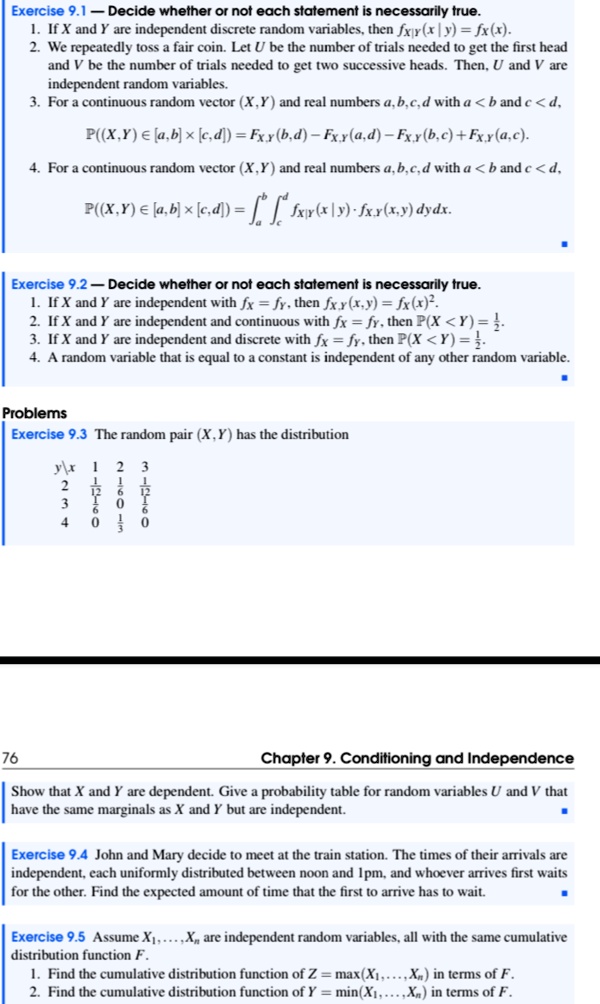
Exercise 9.3 The random pair (X, Y) has the distribution
yx 1 2 3
2
!!!!
3
4
0
0
12160
76
Chapter 9. Conditioning and Independence
Show that X and Y are dependent. Give a probability table for random variables U and V that
have the same marginals as X and Y but are independent.
Exercise 9.4 John and Mary decide to meet at the train station. The times of their arrivals are
independent, each uniformly distributed between noon and 1pm, and whoever arrives first waits
for the other. Find the expected amount of time that the first to arrive has to wait.
.
Exercise 9.5 Assume X1,..., X, are independent random variables, all with the same cumulative
distribution function F.
1. Find the cumulative distribution function of Z = max(X1,..., X₁) in terms of F.
2. Find the cumulative distribution function of Y = min(X1,...,X) in terms of F.