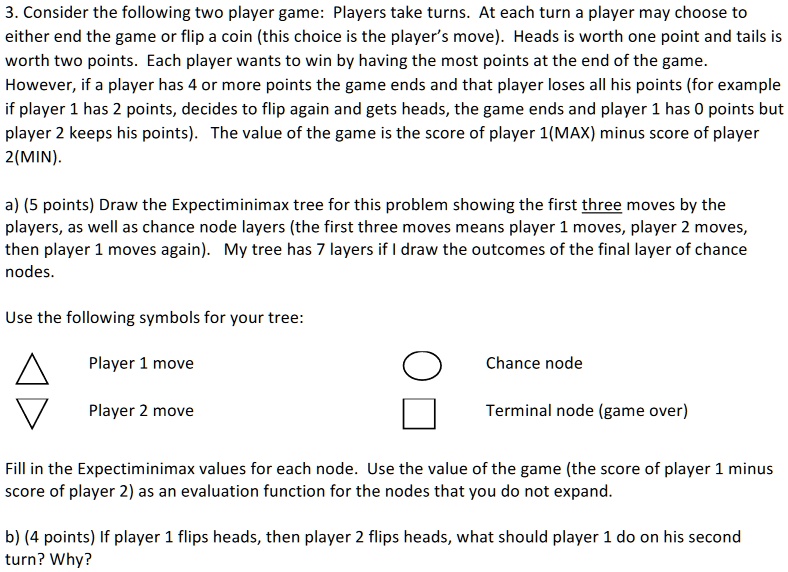
Consider the following two-player game: Players take turns. At each turn, a player may choose to either end the game or flip a coin (this choice is the player's move). Heads is worth one point and tails is worth two points. Each player wants to win by having the most points at the end of the game. However, if a player has 4 or more points, the game ends and that player loses all their points (for example, if player 1 has 2 points, decides to flip again and gets heads, the game ends and player 1 has 0 points but player 2 keeps their points). The value of the game is the score of player 1 (MAX) minus the score of player 2 (MIN).
a) (5 points) Draw the Expectiminimax tree for this problem, showing the first three moves by the players, as well as chance node layers (the first three moves mean player 1 moves, player 2 moves, then player 1 moves again). My tree has 7 layers if I draw the outcomes of the final layer of chance nodes.
Use the following symbols for your tree:
- Player 1 move
- Chance node
- Player 2 move
- Terminal node (game over)
Fill in the Expectiminimax values for each node. Use the value of the game (the score of player 1 minus the score of player 2) as an evaluation function for the nodes that you do not expand.
b) (4 points) If player 1 flips heads, then player 2 flips heads, what should player 1 do on their second turn? Why?