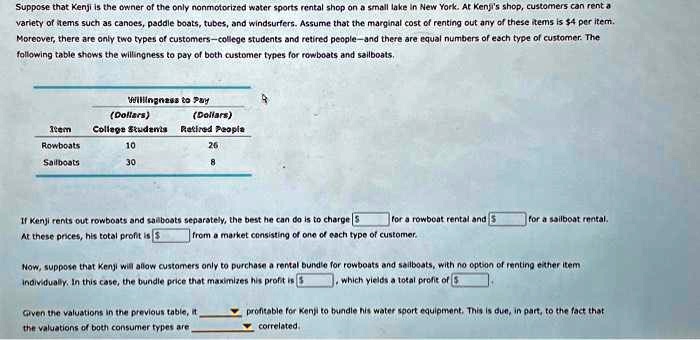
Suppose that Kenji is the owner of the only nonmotorized water sports rental shop on a small lake in New York. At Kenji's shop, customers can rent a variety of items such as canoes, paddle boats, tubes, and windsurfers. Assume that the marginal cost of renting out any of these items is $4 per item. Moreover, there are only two types of customers-college students and retired people-and there are equal numbers of each type of customer. The following table shows the willingness to pay of both customer types for rowboats and sailboats.
Willingness to Pay
(Dollars)
Item
(Dollars)
College Students Retired People
Rowboats
10
26
Sailboats
30
8
If Kenji rents out rowboats and sailboats separately, the best he can do is to charge $\boxed{}$ for a rowboat rental and $\boxed{}$ for a sailboat rental. At these prices, his total profit is $\boxed{}$ from a market consisting of one of each type of customer.
Now, suppose that Kenji will allow customers only to purchase a rental bundle for rowboats and sailboats, with no option of renting either item individually. In this case, the bundle price that maximizes his profit is $\boxed{}$, which yields a total profit of $\boxed{}$.
Given the valuations in the previous table, it $\boxed{}$ profitable for Kenji to bundle his water sport equipment. This is due, in part, to the fact that the valuations of both consumer types are $\boxed{}$ correlated.