Ace - AI Tutor
Ask Our Educators
Textbooks
My Library
Flashcards
Scribe - AI Notes
Notes & Exams
Download App
rebecca ribas

rebecca r.

Divider

Questions asked

BEST MATCH

In each of the following situations, represent the object with a particle. Sketch all the forces acting upon the object, making the length of each vector represent the magnitude of the force. 1. Object lies motionless. 2. Object slides at constant speed without friction 3. Object slows due to kinetic friction. 4. Object slides without friction. 5. Static friction prevents sliding. 6. An object is suspended from the ceiling. 7. An object is suspended from the ceiling. 8. The object is motionless. 9. The object is motionless. 10. The object is motionless. $$vfg$$ $$vfg$$

View Answer
divider
BEST MATCH

26 Depositing money into accounts at financial institutions, mixing it with funds that are legally acquired, or exporting money are all part of which stage of money laundering? R21Dc0kzaDJHamd5TEFjQzlqSjNGUT09 a. Layering stage b. Accumulation stage c. Placement stage d. Integration stage

View Answer
divider
BEST MATCH

14) \( 2 \sec (u) \sin (u)+2=4 \sin (u)+\sec (u) \)

View Answer
divider
BEST MATCH

Increased rate coding (activation) and recruitment of new motor units are two ways the brain can increase muscle force. O True O False

View Answer
divider
BEST MATCH

A Train is moving with a constant Velocity of 10 m/s. The displacement has to be found of the train such that the time covered is 5 seconds.

View Answer
divider
BEST MATCH

25. Complete the following feedback loop for estrogen between day 12 and 14 of ovarian cycle. (Select answer from Section 1) ? (Select answer from Section 2) ? (Select answer from Section 1) ? (Select answer from Section 2) ? (Select answer from Section 2) ? (Select answer from Section 1) ? (Select answer from Section 2) ? (Select answer from Section 3) Section 1 A. hypothalamus B. posterior pituitary C. anterior pituitary D. ovaries E. uterus Section 2 F. increase GnRH G. decrease GnRH H. increase FSH I. decrease FSH J. increase LH K. decrease LH L. increase estrogen M. decrease estrogen Section 3 N. negative feedback loop O. positive feedback loop

View Answer
divider
BEST MATCH

Go online and search for 3 database administration job postings in your area. Provide the link or a screen shot of the job posting. Compare the job posting to the roles and responsibilities discussed in this module. Which ones were echoed in the job postings? What responsibilities were called out in the job posting that weren't discussed/identified in the powerpoint for this module? Should those additional responsibilities be called out in the module presentation?

View Answer
divider
BEST MATCH

D?=D?= 2 N-m-s/rad, J?=J?= 2 kg/m², K=3 N/m. The transfer function of the system T(s) (Theta? is the output and The torque is the input) is

View Answer
divider
BEST MATCH

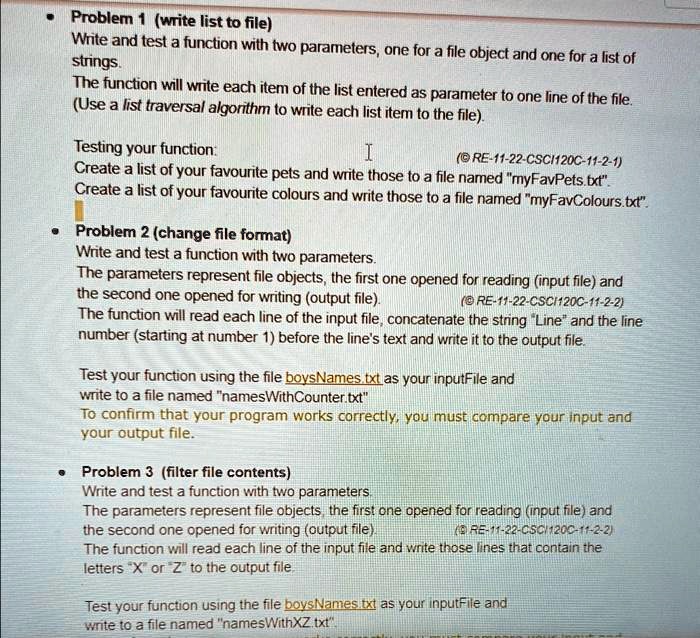
Problem 1 (write list to file): Write and test a function with two parameters, one for a file object and one for a list. The function will write each item of the list entered as a parameter to one line of the file. Use a list traversal algorithm to write each list item to the file. Testing your function: T RE-11-22-CSCI120C-11-2-1 Create a list of your favorite pets and write those to a file named "myFavPets.txt". Create a list of your favorite colors and write those to a file named "myFavColors.txt". Problem 2 (change file format): Write and test a function with two parameters. The parameters represent file objects, the first one opened for reading (input file) and the second one opened for writing (output file). The function will read each line of the input file, concatenate the string "Line" and the line number (starting at number 1) before the line's text, and write it to the output file. Test your function using the file "boysNames.txt" as your input file and write to a file named "namesWithCounter.txt". To confirm that your program works correctly, you must compare your input and your output file. Problem 3 (filter file contents): Write and test a function with two parameters. The parameters represent file objects, the first one opened for reading (input file) and the second one opened for writing (output file). The function will read each line of the input file and write those lines that contain the letters X or Z to the output file. Test your function using the file "boysNames.txt" as your input file and write to a file named "namesWithXZ.txt".
View Answer
divider
BEST MATCH

Phosgene is formed from chlorine and carbon monoxide through the overall reaction: CO(g) + Cl2(g) ? COCl2(g) whose rate equation is given by r = k [CO] [Cl2]<sup>3/2</sup>. Assuming all concentrations are (unrealistically) in Molar and time in seconds, what are the units of k? The numerical value of k for these units is 0.0001. Using this information and taking initial concentrations of phosgene, CO and Cl2 to be 0 M, 10 M and 12 M respectively, numerically integrate (use Euler's method) the overall rate expression for phosgene formation and plot the concentrations of CO, Cl2 and COCl2 as a function of time. Assume the reaction mechanism for the above reaction is: i) Cl2 \iff 2Cl ii) Cl + CO \rightarrow COCl iii) COCl + Cl2 \rightarrow COCl2 + Cl (very fast step; [Cl] = (k1 [Cl2])<sup>1/2</sup>; K? = 0.5) (elementary reaction; k2 = 0.002) (elementary reaction; k3 = 0.001) The first step is a very fast reaction and the concentration of Cl radical (Cl) for all the steps overall is [Cl] = (k1 [Cl2])<sup>1/2</sup> where K? = 0.5 M (equilibrium constant). The second and third steps are elementary reactions with k2 = 0.002 M<sup>-1</sup>s<sup>-1</sup> and k3 = 0.001 M<sup>-1</sup>s<sup>-1</sup> (rate constants). Plot the concentrations of Cl and COCl as the reaction proceeds over time.

View Answer
divider