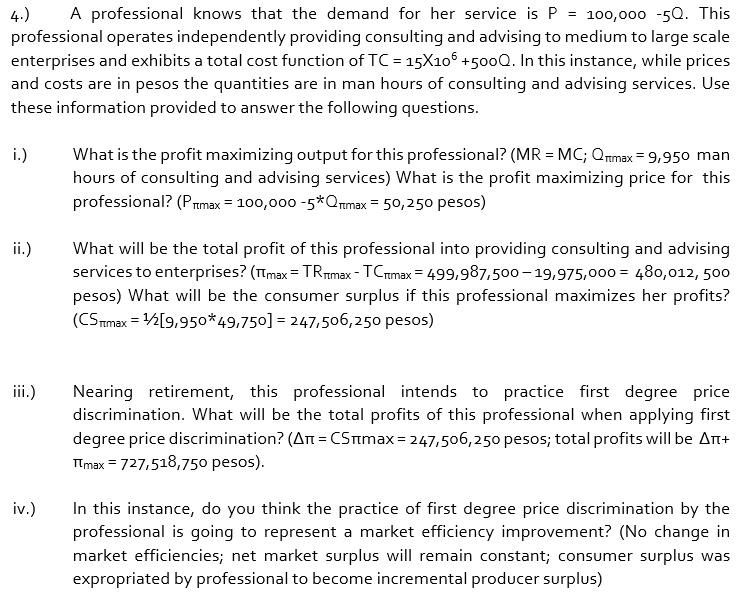
4.)
A professional knows that the demand for her service is P = 100,000 -5Q. This professional operates independently providing consulting and advising to medium to large scale enterprises and exhibits a total cost function of TC = 15X10<sup>6</sup> +500Q. In this instance, while prices and costs are in pesos the quantities are in man hours of consulting and advising services. Use these information provided to answer the following questions.
i.) What is the profit maximizing output for this professional? (MR = MC; Q<sub>?max</sub> = 9,950 man hours of consulting and advising services) What is the profit maximizing price for this professional? (P<sub>?max</sub> = 100,000 -5*Q<sub>?max</sub> = 50,250 pesos)
ii.) What will be the total profit of this professional into providing consulting and advising services to enterprises? (?<sub>max</sub> = TR<sub>?max</sub> - TC<sub>?max</sub> = 499,987,500 -19,975,000 = 480,012,500 pesos) What will be the consumer surplus if this professional maximizes her profits? (CS<sub>?max</sub> = 1/2[9,950*49,750] = 247,506,250 pesos)
iii.) Nearing retirement, this professional intends to practice first degree price discrimination. What will be the total profits of this professional when applying first degree price discrimination? (?? = CS<sub>?max</sub> = 247,506,250 pesos; total profits will be ??+ ?<sub>max</sub> = 727,518,750 pesos).
iv.) In this instance, do you think the practice of first degree price discrimination by the professional is going to represent a market efficiency improvement? (No change in market efficiencies; net market surplus will remain constant; consumer surplus was expropriated by professional to become incremental producer surplus)