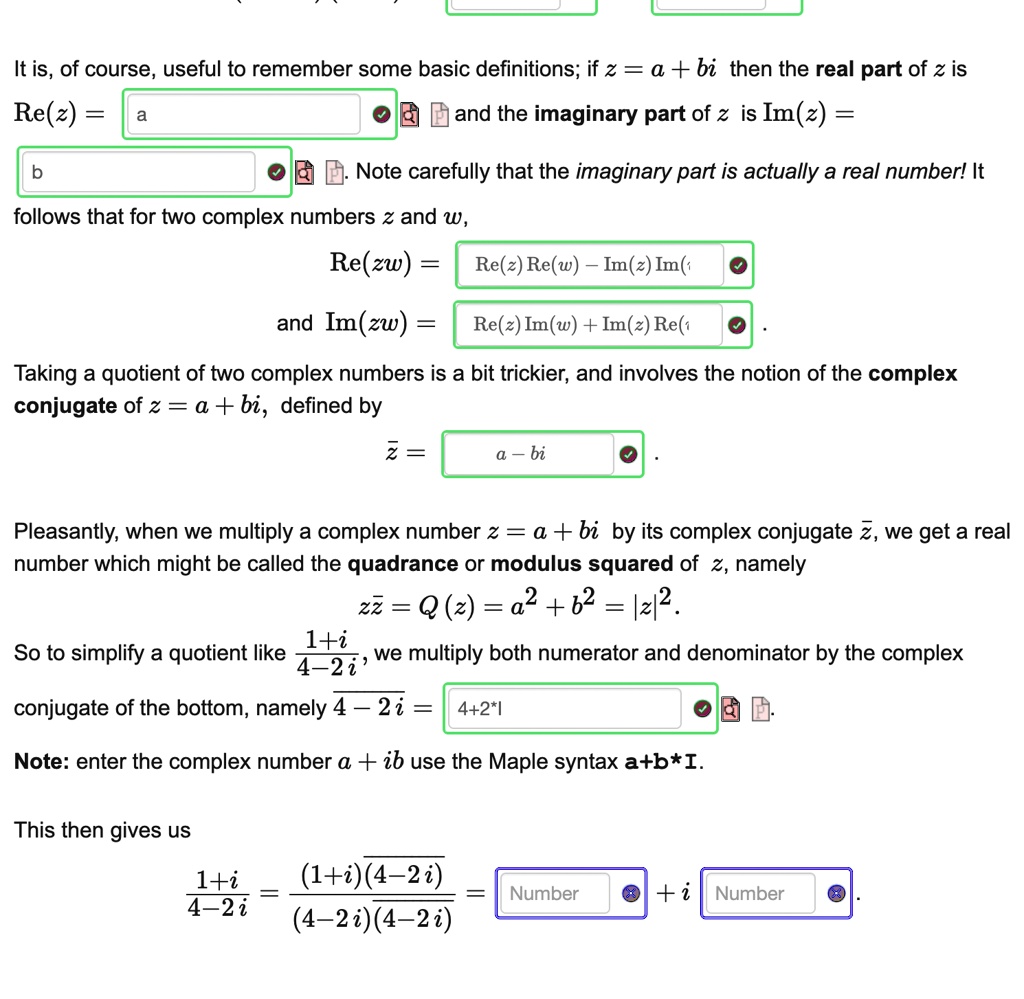
It is, of course, useful to remember some basic definitions; if z = a + bi then the real part of z is Re(z) and the imaginary part of z is Im(z). Note carefully that the imaginary part is actually a real number! It follows that for two complex numbers z and w, Re(zw) = Re(z)Re(w) - Im(z)Im(w) and Im(zw) = Re(z)Im(w) + Im(z)Re(w). Taking a quotient of two complex numbers is a bit trickier, and involves the notion of the complex conjugate of z = a + bi, defined by z = a - bi. Pleasantly, when we multiply a complex number z = a + bi by its complex conjugate z, we get a real number which might be called the quadrance or modulus squared of z, namely zz = Q(z) = a^2 + b^2 = |z|^2. So to simplify a quotient like (1+i)/(4-2i), we multiply both numerator and denominator by the complex conjugate of the bottom, namely 4 + 2*I. Note: enter the complex number a + ib using the Maple syntax a + b*I. This then gives us (1+i)(4-2i) / ((4-2i)(4-2i)).