Questions asked
y^(**)-y=t,y(0)=1,y^(')(0)=1 başlangıç değer probleminin Laplace dönüşümū ile çōzümū için gerekli Y(s) aşağıdakilerden hangisidir? a) (1)/(s-1) (1)/(s^(2)-1) (1)/(s^(2)) b) (1)/(s-1) (1)/(s^(2)) c) (1)/(s-1) (1)/(s^(2)-1) c) (1)/(s^(2)-1) (1)/(s^(2)) e) (1)/(s-1) (s)/(s^(2)-1) (1)/(s) soruda verilen başlangıç değer probleminin çözümü y(t) aşağıdakilerden hangisidir? e) te^(') cosht t a) te^(t) cosht t b) e^(') sinht-t c) e^(') cosht t d) sinht
Find the location of the comma after the street address. Use a SEARCH function. Use the location of the first comma as the start_num. Adjust the start_num to start one past that location to account for the space after the comma. Copy and paste down to complete the column. 1.1 Find the location of the space between the first and last names. Use a SEARCH function. Copy and paste down to complete the column. 2.5 1.2 Find the location of the comma after the last name. Use a SEARCH function. Copy and paste down to complete the column.
RETIREMENT NEEDS ANALYSIS LS = Lump Sum needed at requirement to fund benefit x y = annual savings needed to accumulate LS x = annual retirement income CA = Current Assets DA = Amount client wishes to have left at death STEP ONE: Solve for x. A. Ascertain the annual amount of income the client wishes to have for retirement and subtract their estimated social security benefit from it. B. Enter the amount of income from A above into your calculator as PV. Enter your inflation assumption as “I”. Determine the pre-retirement period (age at which the client plans to retire, less his current age) and enter that number as “n”. Solve for FV (future value). This is the amount of money needed to fund the first year of retirement. This is x. STEP TWO: Solve for LS A. Change your calculator to “begin” mode, because your client will need their income at the beginning of the year. Enter “x” as “PMT”. B. Determine your inflation adjusted rate of return: [ (1+expected return)/(1+inflation rate) – 1] X 100 Enter this as “I”. C. Determine the post-retirement period (number of years from retirement age to death) and enter this as “n”. Enter DA as the FV. D. Solve for PV. This is the amount of money the client must have amassed by retirement age to fund their retirement income. This is LS. STEP THREE: Solve for y (level payment) A. Change calculator back to “end” mode and set for 12 periods/year. B. Enter CA as PV. Enter pre-retirement period as “n” (and multiply by 12 if required). Enter your expected rate or return as “I”. Enter your LS as FV. A. Solve for PMT. PMT = y (level payment). VARIABLES: Current age: _________22_________ Retirement age: _______65_______ Age at death: _________87_________ Amount of annual income needed at retirement (in today’s dollars): $__________ Estimated social security benefit (annualized): $_______________ Amount left over at death: $__________________________ Current assets available for retirement: $______________________ ASSUMPTIONS: Inflation rate: ________% Expected rate of return: __________%
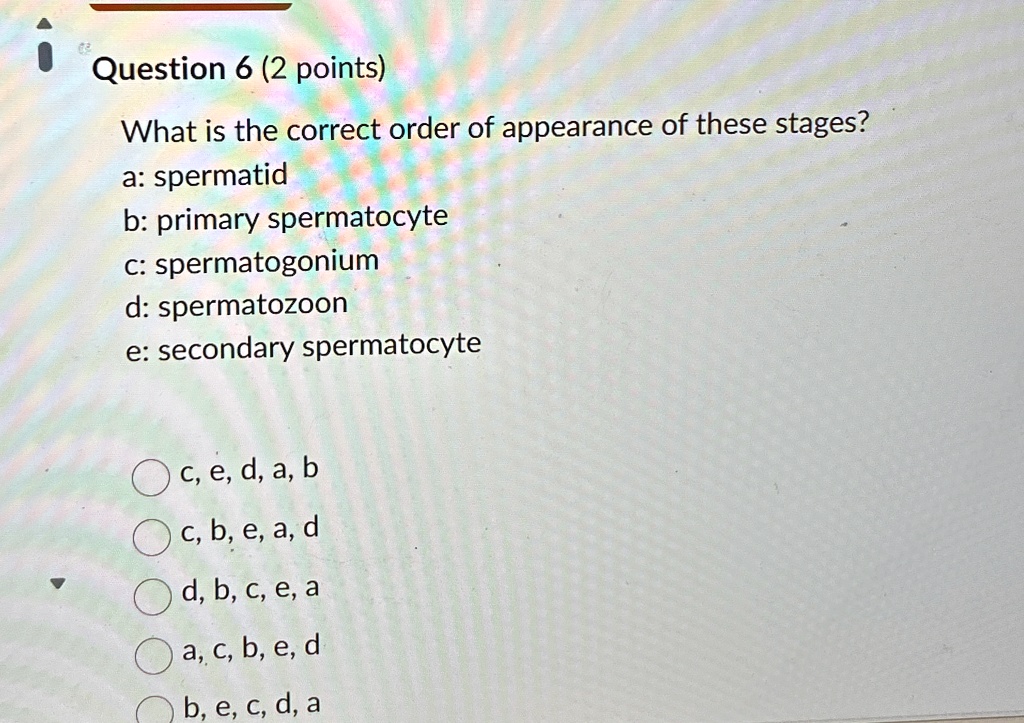
Question 6 (2 points) What is the correct order of appearance of these stages? a: spermatid b: primary spermatocyte c: spermatogonium d: spermatozoon e: secondary spermatocyte c, e, d, a, b c, b, e, a, d d, b, c, e, a a, c, b, e, d b, e, c, d, a
1. Bentham was a hedonistic utilitarian who focused only on the total quantity of pleasure an action produces. 2. Mill was a utilitarian who focused on both the quantity and quality of pleasure an action produces. 3. According to Hobbes, author of Leviathan, life in the state of nature is solitary, poor, nasty, brutish, and short. 4. According to the Principle of Utility, we must do the action that maximizes overall well-being, producing the greatest good for the greatest number. 5. According to the social contract theory, actions are morally right just because they are permitted by rules that free, equal, and rational people would agree to live by.
R L \text{m} 39 \Omega 82 \mu H C 1.5 nF V_S 3.0 V Find the resonant frequency, the cutoff frequencies and the bandwidth of the circuit.
Express the limit as a definite integral on the given interval.\\ $\lim_{n \to \infty} \sum_{i=1}^{n} \frac{\cos(x_i)}{x_i} \Delta x$, $[3\pi, 4\pi]$ \\ $\int_{3\pi}^{4\pi} \text{____ } dx$
As an electron moves through a region of space, its speed decreases from 8.50 x 10$^6$ m/s to 2.50 x 10$^6$ m/s. The electric force is the only force acting on the electron: (a) Did the electron move to a higher potential or a lower potential? (b) Across what potential difference did the electron travel? Draw a picture of the system with the field.
Find crossover rate, rounded to 6 decimal places. Project A: -1000, 950, 500 Project B: -500, 550, 350 Options: 7.823300%, 9.725560%, 6.336595%, 6.369947%
Problem 10a What is Fourier transform, give its definition. Problem 10b When can we use them in engineering applications? Problem 10c Find the Fourier Transform of the following function, x(t) $F[x(t)] = X(\omega)$ x(t) = 1, as $-1 < t < 1$ x(t) = 0, as $-\infty < t < -1$ x(t) = 0, as $1 < t < \infty$