Ace - AI Tutor
Ask Our Educators
Textbooks
My Library
Flashcards
Scribe - AI Notes
Notes & Exams
Download App
rebecca vargas

rebecca v.

Divider

Questions asked

BEST MATCH

How is it that people working in their own self-interest produce goods, services, and wealth for others? Time left 0:23: Select one: O a. By taking advantage of a vast supply of labor, people working in their own self-interest could hire others at very low wages O b. In order to earn money and produce goods that improve lives, self-directed gain would provide jobs, and subsequently wages for others O c. The government pays entrepreneurs in the U.S. to produce goods, services, and wealth for others O d. Entrepreneurs tend to include themselves in a group of people who need charitable support. A portion of the entrepreneur's profit (as required by law) goes to the charity of one's choice to support the less fortunate

View Answer
divider
BEST MATCH

Multiple Choice: Which of the following is not a stated policy of the Neoliberal Free Market? Establishing a democratic society. Eliminating tariffs and restrictions on trade. Removing price controls from the market. Authorizing the privatization of publicly-owned assets.

View Answer
divider
BEST MATCH

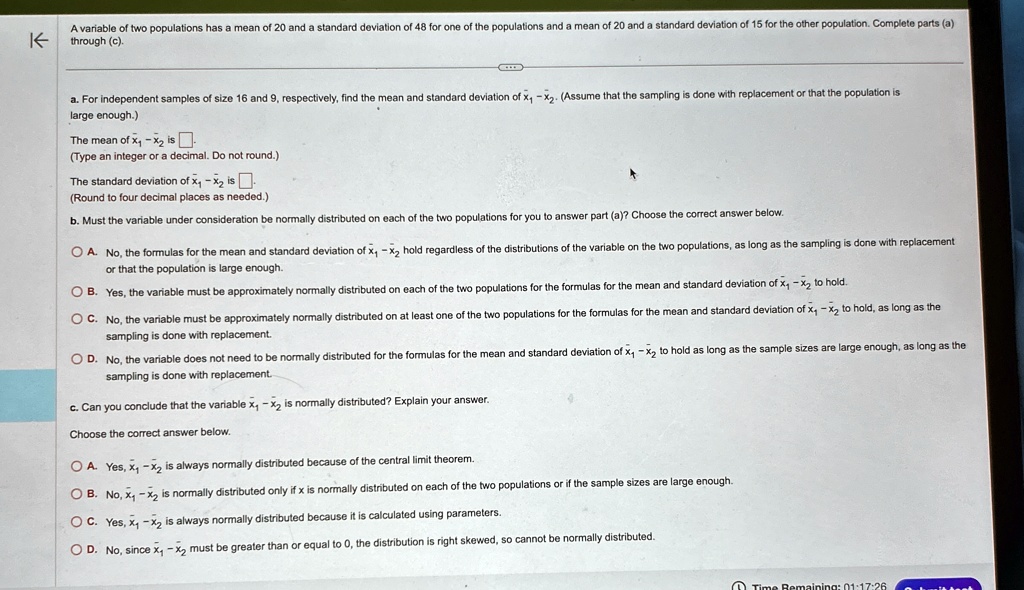
A variable of two populations has a mean of 20 and a standard deviation of 48 for one of the populations and a mean of 20 and a standard deviation of 15 for the other population. Complete parts (a) through (c). a. For independent samples of size 16 and 9, respectively, find the mean and standard deviation of $x_1-x_2$. (Assume that the sampling is done with replacement or that the population is large enough.) The mean of $x_1-x_2$ is $\boxed{}$. (Type an integer or a decimal. Do not round.) The standard deviation of $x_1-x_2$ is $\boxed{}$. (Round to four decimal places as needed.) A b. Must the variable under consideration be normally distributed on each of the two populations for you to answer part (a)? Choose the correct answer below. A. No, the formulas for the mean and standard deviation of $x_1-x_2$ hold regardless of the distributions of the variable on the two populations, as long as the sampling is done with replacement or that the population is large enough. OB. Yes, the variable must be approximately normally distributed on each of the two populations for the formulas for the mean and standard deviation of $x_1-x_2$ to hold. OC. No, the variable must be approximately normally distributed on at least one of the two populations for the formulas for the mean and standard deviation of $x_1 - x_2$ to hold, as long as the sampling is done with replacement. OD. No, the variable does not need to be normally distributed for the formulas for the mean and standard deviation of $x_1-x_2$ to hold as long as the sample sizes are large enough, as long as the sampling is done with replacement. c. Can you conclude that the variable $x_1 - x_2$ is normally distributed? Explain your answer. Choose the correct answer below. A. Yes, $x_1-x_2$ is always normally distributed because of the central limit theorem. B. No, $x_1-x_2$ is normally distributed only if x is normally distributed on each of the two populations or if the sample sizes are large enough. OC. Yes, $x_1-x_2$ is always normally distributed because it is calculated using parameters. OD. No, since $x_1 - x_2$ must be greater than or equal to 0, the distribution is right skewed, so cannot be normally distributed. Time Remaining: 01:17:26
View Answer
divider
BEST MATCH

dy+Weinber+Practice+Problem 1. In a population of 100 people, 16 people cannot roll their tongue. Based on this information, answer the following questions (show your work): a. (1 point) What is the frequency of recessive alleles in the population? b. (1 point) What is the frequency of the dominant allele? c. (2 points) How many people in this population would you expect to be heterozygous for tongue rolling if all assumptions of Hardy-Weinberg were met? d. (2 points) If I told you that of the remaining 84 people in the population, 16 are homozygous dominant and 68 are heterozygous, is this population in Hardy-Weinberg equilibrium? e. (2 points) How do you interpret what your answer in d means (i.e. what does it mean if a population is/is not in Hardy-Weinberg equilibrium in terms of evolutionary biology)?

View Answer
divider
BEST MATCH

In a _____________, most economic decisions about what and how much to produce are made by the interaction of private individuals and organizations. A. market economy B. macroeconomy C. traditional economy D. command economy E. none of the above

View Answer
divider
BEST MATCH

Ex#3 In Exercises 1-6, use Eq. (2) to estimate.

View Answer
divider
BEST MATCH

On a neuronal level, some antidepressants work by inhibiting the attachment of acetylcholine to the receptor sites increasing levels of norepinephrine and serotonin decreasing levels of GABA and dopamine producing higher levels of endorphins

View Answer
divider
BEST MATCH

Which of the following countries could be used as examples of "Political Capitalism"?

View Answer
divider
BEST MATCH

Which of the following statements is false about epithelial tissue? Multiple Choice Epithelial tissue is composed of cells and a thick vascular matrix. Epithelial tissue functions in absorption. Epithelial cells can be cube or column shaped. Epithelial cells do not secrete a ground substance.

View Answer
divider
BEST MATCH

Sketch the bode (magnitude and phase) plot of the following transfer function (Use radians/s.): (Note: M is for Mega, even though in LTspice m=M=milli and you have to use Meg) $H(s) = \frac{(s + 20) \times 200M}{(s + 20k) \times (s + 200k)}$

View Answer
divider