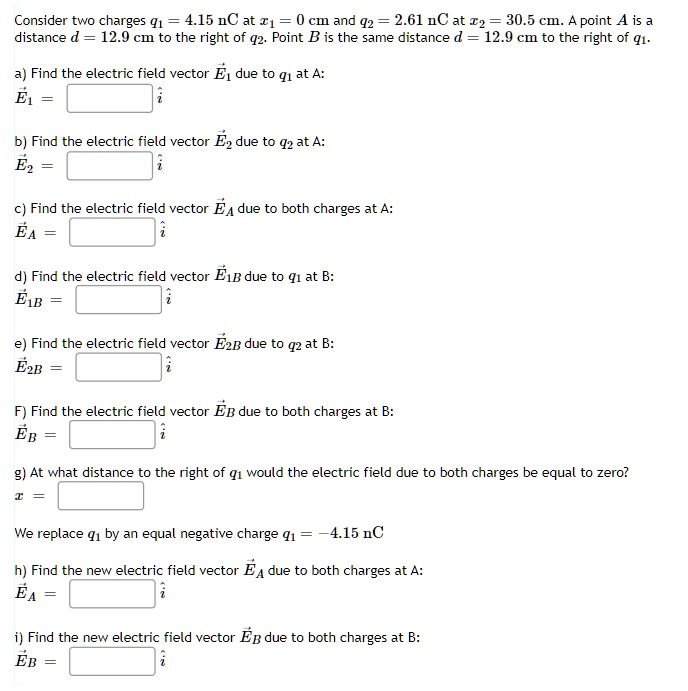
Consider two charges q_(1)=4.15nC at x_(1)=0cm and q_(2)=2.61nC at x_(2)=30.5cm. A point A is a
distance d=12.9cm to the right of q_(2). Point B is the same distance d=12.9cm to the right of q_(1).
a) Find the electric field vector vec(E)_(1) due to q_(1) at A:
vec(E)_(1)=,hat(i)
b) Find the electric field vector vec(E)_(2) due to q_(2) at A:
vec(E)_(2)=,hat(i)
c) Find the electric field vector vec(E)_(A) due to both charges at A:
vec(E)_(A)=,hat(i)
d) Find the electric field vector vec(E)_(1B) due to q_(1) at B :
vec(E)_(1B)=,hat(i)
e) Find the electric field vector vec(E)_(2B) due to q_(2) at B :
vec(E)_(2B)=,hat(i)
F) Find the electric field vector vec(E)_(B) due to both charges at B:
vec(E)_(B)=,hat(i)
g) At what distance to the right of q_(1) would the electric field due to both charges be equal to zero?
x=
We replace q_(1) by an equal negative charge q_(1)=-4.15nC
h) Find the new electric field vector vec(E)_(A) due to both charges at A:
vec(E)_(A)=,hat(i)
i) Find the new electric field vector vec(E)_(B) due to both charges at B :
vec(E)_(B)=,hat(i)
Consider two charges q1 = 4.15 nC at = 0 cm and q2 = 2.61 nC at 2 = 30.5 cm. A point A is a distance d = 12.9 cm to the right of q2. Point B is the same distance d = 12.9 cm to the right of q1.
a) Find the electric field vector E due to q1 at A: E1
b) Find the electric field vector E2 due to q2 at A: E2
c) Find the electric field vector E4 due to both charges at A: EA=
d) Find the electric field vector E1B due to q1 at B: EB
e) Find the electric field vector E2B due to q2 at B: E2B
F) Find the electric field vector EB due to both charges at B: EB (*6
g) At what distance to the right of q1 would the electric field due to both charges be equal to zero?
We replace q1 by an equal negative charge q1 = -4.15 nC
h) Find the new electric field vector E4 due to both charges at A: EA
i) Find the new electric field vector EB due to both charges at B: EB=