Ace - AI Tutor
Ask Our Educators
Textbooks
My Library
Flashcards
Scribe - AI Notes
Notes & Exams
Download App
rebecca west

rebecca w.

Divider

Questions asked

BEST MATCH

Determine the margin of error for the confidence interval for the mean 24 plus or minus 2.1

View Answer
divider
BEST MATCH

13 Multiple Choice 1 point Eccentric muscle contractions can best be described as which of the following? Contractions that involve muscle lengthening Contractions that involve muscle shortening Contractions that have no length change Clear my selection Previous

View Answer
divider
BEST MATCH

Determine the gravitational exerted by the sun on a 1.0 kg object on the surfave of the. Earth

View Answer
divider
BEST MATCH

liters (mL). cylinder and s. 50 ml 40 30 20

View Answer
divider
BEST MATCH

If \( f(x)=5 \sin (5 x) \sin ^{-1}(x) \), \[ f^{\prime}(x)= \]

View Answer
divider
BEST MATCH

Saved failures.____is the tendency to overestimate the contribution of internal factors to one's successes and the contributi Multiple Choice Fundamental attribution error Self-serving bias External attribution error Internal attribution error

View Answer
divider
BEST MATCH

Determine the amount of money, to the nearest dollar, you must invest at 5% per year, compounded annually, so you will be a millionaire in 34 years.

View Answer
divider
BEST MATCH

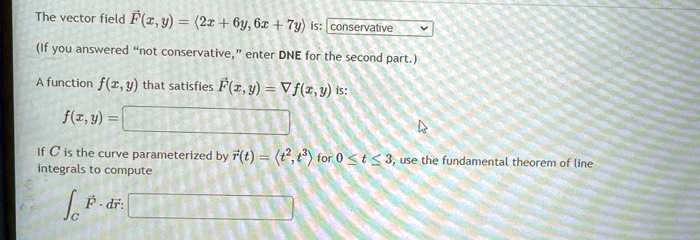
The vector field \(F(x,y) = (2x+6y, 6x+7y)\) is: conservative (If you answered \"not conservative\", enter DNE for the second part.) A function \(f(x, y)\) that satisfies \(F(x, y) = \nabla f(x, y)\) is: \(f(x, y) = \) If C is the curve parameterized by \(\vec{r}(t) = (t^2, t^3)\) for \(0 \le t \le 3\), use the fundamental theorem of line integrals to compute \(\int_C \vec{F} \cdot d\vec{r}:\)
View Answer
divider
BEST MATCH

"If you can't measure it, you can't ..." a) manage it. b) sell it c) improve it d) justify it e) pay for it

View Answer
divider
BEST MATCH

1.8 points) Verify that the following are true. Hint: Start from the left-hand side of the equations. Rewrite the left side either by using identities/formulas or using definitions of trigonometric functions, or doing "some algebra". Try to obtain the expressions on the right-hand side of the equations. Suggestion: Re-writing each term using sine and cosine might help you see how both sides are related. (Warning: Trying out some angles to see whether they work does not verify that the statement is true for all angles! Do not just try out values.) (a) 1 (b) ln(sin(x)) + ln|sec(x)| = ln(tan(x)) (c) sin(x) - cos(x) - 2cos(2x)cos(x)sin(x)sin(2x) (d) cos(4x) = 2cos(2x) - 1 Quadrant 3, find cos(-a) exactly. (Hint: use the sum/difference formulas)

View Answer
divider