Ace - AI Tutor
Ask Our Educators
Textbooks
My Library
Flashcards
Scribe - AI Notes
Notes & Exams
Download App
rebekah tirado

rebekah t.

Divider

Questions asked

BEST MATCH

If a prairie dog had the opportunity to perform an altruistic act (i.e., give an alarm call) to help its relatives, which of the following combinations of the following relatives would the prairie dog be most likely to help? (Base your answer solely on the genetic relationships.) Four cousins and one full brother Two nieces, two cousins, and one half-brother One son Two half-sisters and two nieces

View Answer
divider
BEST MATCH

QUESTION 5 The stretch reflex, or myotatic reflex, is provoked by activation of which of the following in a stretched muscle? O muscle spindles O golgi tendon organs O both muscle spindles and golgi tendon organs O neither muscle spindles nor golgi tendon organs

View Answer
divider
BEST MATCH

An infinitely long cylinder of radius 4.0 cm carries a uniform volume charge density $\rho = 300 \, nC/m^3$. What is the electric field at $r = 3.9 \, cm$? zero 0.44 kN/C 0.57 N/C 0.11 kN/C 0.66 kN/C

View Answer
divider
BEST MATCH

What is the pOH of a 0.5 M ethylamine solution? Kb = 3.8 x 10⁻¹⁰

View Answer
divider
BEST MATCH

Question 1 Match these arguments with their authors. Half a point for each correct answer. We should respect each culture's autonomy, even if they are "oppressive" by our standards, because people deserve to live in a society of their own choosing. Acting while "intending" to kill someone is the same as acting while "foreseeing" that someone will die, so our moral assessment of the action should be independent of the intend/foresee distinction. The duty to not violate noninterference is more pressing than the duty to provide a service, so the latter can be violated more easily. The moral values and principles that we hold most dear derive ultimately from our communal belonging, so we owe a special patriotic allegiance to our society. [Choose] Macintyre Foot Walzer McPherson [Choose]

View Answer
divider
BEST MATCH

4. Physician orders: Ceftriaxone 35 mg/kg/12-hour dose, weight is 18 lbs. Available: Ceftriaxone 500 mg/30 mL. Round all answers to the nearest tenth. What is the mg dose? What is the mL dose?

View Answer
divider
BEST MATCH

For the state of stress shown, determine the maximum shearing stress in 3D. 3 ksi Maximum shear stress = 3.5 kips Maximum shear stress = 3.5 Pa Maximum shear stress = 3.5 psi Maximum shear stress = 35 kips 2 ksi 6 ksi

View Answer
divider
BEST MATCH

Observation in Physical Therapy (PT) and or Occupational Therapy (OT) Objectives: Upon completion of the observational experience, the student will be able to: 1. Describe the role of the physical therapist and/or occupational therapist as a health team member. 2. Identify factors that influence mobility and activities of daily living. 3. Identify equipment used for physical therapy and/or occupational therapy. 4. Discuss the functions of equipment used for physical therapy and occupational therapy. 5. Differentiate between active and passive range of motion (ROM). 6. Describe common methods to assess mobility and self-care. 7. Teach safety precautions for patients with altered mobility and/or for self-care deficit. 8. Identify psychosocial concerns of patients with: a) altered mobility b) self-care deficit c) altered role performance 9. Describe effective communication techniques used by the physical therapist and/or occupational therapist. 10. Identify expected outcomes for clients with: a) altered mobility b) self-care deficit c) altered role performance 11. Describe nursing interventions which can enhance the effectiveness of the client's physical therapy or occupational therapy. 12. Discuss the impact of disability on the client's life.

View Answer
divider
BEST MATCH

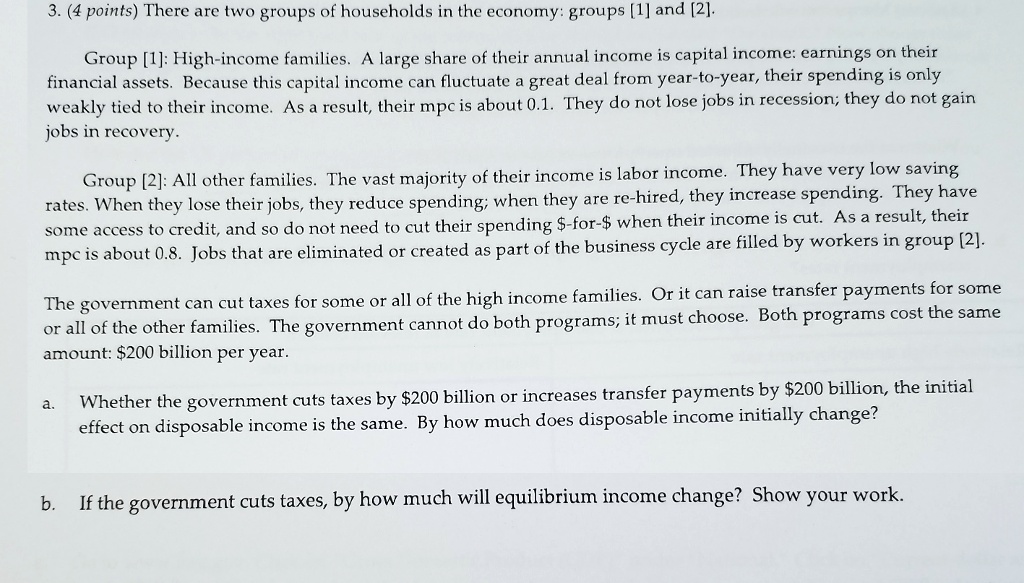
3. (4 points) There are two groups of households in the economy: groups [1] and [2]. Group [1]: High-income families. A large share of their annual income is capital income: earnings on their financial assets. Because this capital income can fluctuate a great deal from year-to-year, their spending is only weakly tied to their income. As a result, their mpc is about 0.1. They do not lose jobs in recession; they do not gain jobs in recovery. Group [2]: All other families. The vast majority of their income is labor income. They have very low saving rates. When they lose their jobs, they reduce spending; when they are re-hired, they increase spending. They have some access to credit, and so do not need to cut their spending $-for-$ when their income is cut. As a result, their mpc is about 0.8. Jobs that are eliminated or created as part of the business cycle are filled by workers in group [2]. The government can cut taxes for some or all of the high income families. Or it can raise transfer payments for some or all of the other families. The government cannot do both programs; it must choose. Both programs cost the same amount: $200 billion per year. a. Whether the government cuts taxes by $200 billion or increases transfer payments by $200 billion, the initial effect on disposable income is the same. By how much does disposable income initially change? b. If the government cuts taxes, by how much will equilibrium income change? Show your work.
View Answer
divider
BEST MATCH

T1 = 100 C • ksi = 124 W/mC • Kep = 10 W/mC • kcu = 390 W/mC • Area = 0.01 m^2 Silicon Epoxy Copper T4 = 20 C 10 mm 5 mm 15 mm Relevant equations: $R_{cond} = \frac{L}{kA}$ $q_{cond} = \frac{T_1 - T_4}{\sum R_{tot}}$ $q'' = \frac{q_{cond}}{A}$ OR $\begin{bmatrix} F \end{bmatrix} = \begin{bmatrix} K \end{bmatrix} \begin{bmatrix} t \end{bmatrix}$ $\begin{bmatrix} k_c \end{bmatrix} = \frac{AK_{xx}}{L} \begin{bmatrix} 1 & -1\\-1 & 1 \end{bmatrix}$ $\begin{bmatrix} D \end{bmatrix} = \begin{bmatrix} K_{xx} \end{bmatrix}$ $q_x = -\begin{bmatrix} D \end{bmatrix} \begin{bmatrix} g \end{bmatrix}$

View Answer
divider