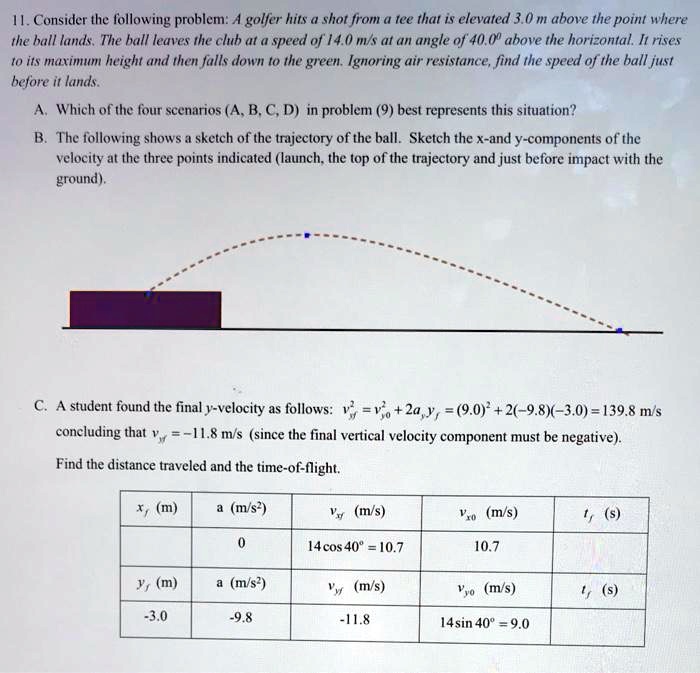
11. Consider the following problem: A golfer hits a shot from a tee that is elevated 3.0 m above the point where
the ball lands. The ball leaves the club at a speed of 14.0 m/s at an angle of 40.0º above the horizontal. It rises
to its maximum height and then falls down to the green. Ignoring air resistance, find the speed of the ball just
before it lands.
A. Which of the four scenarios (A, B, C, D) in problem (9) best represents this situation?
B. The following shows a sketch of the trajectory of the ball. Sketch the x-and y-components of the
velocity at the three points indicated (launch, the top of the trajectory and just before impact with the
ground).
C. A student found the final y-velocity as follows: $v_y^2 = v_{y0}^2 + 2a_y y$ = (9.0)²+2(-9.8)(-3.0) = 139.8 m/s
concluding that $v_y$ = -11.8 m/s (since the final vertical velocity component must be negative).
Find the distance traveled and the time-of-flight.
x, (m) a (m/s²)
$v_f$ (m/s)
$v_{x0}$ (m/s)
$t_f$ (s)
0
14 cos 40° = 10.7
10.7
y, (m)
a (m/s²)
$v_{yf}$ (m/s)
$v_{y0}$ (m/s)
$t_f$ (s)
-3.0
-9.8
-11.8
14 sin 40° = 9.0