Ace - AI Tutor
Ask Our Educators
Textbooks
My Library
Flashcards
Scribe - AI Notes
Notes & Exams
Download App
remedios wallace

remedios w.

Divider

Questions asked

BEST MATCH

Does staff training in de-escalation techniques reduce the occurrence of patient to nurse violence? Dependent Variable(s) [Choose] Independent Variable(s) [Choose]

View Answer
divider
BEST MATCH

Host behaviors can be manipulated by the pathogen to increase the chances of pathogen transmission. A. True B. False

View Answer
divider
BEST MATCH

High oxygen content in water is an indication that Multiple Choice there are no contaminants present at all. water is clean enough to support game fish. sewage, paper pulp, or food processing wastes have been added to the water. water is only able to support algae and bacteria. there is a large population of coliform bacteria.

View Answer
divider
BEST MATCH

Having said that, Here are a few questions we can ask ourselves when trying to determine whether a social issue is actually a social problem: Is there a public outcry about the conduct or the condition? Are people actively discussing the issue and demanding that a resolution be found? Does the conduct or condition reflect a gap between social ideals and social reality? What social ideals are involved? What is the social reality about the situation? Are a large number of people involved in defining the problem and demanding that a solution be found? Does the matter have national attention? If not - is it a special-interest group the primary source of demands that something be done about the condition? Can a solution be found for the issue? If not, can we reduce the problem or alleviate the suffering of some victims of the problem? The task for Part 1 of the Assignment: Based on these questions, what pressing social issues are we overlooking in our nation that should be considered as social problems requiring immediate action? Does this issue receive media attention? If yes - how so and if not, why do you think that is? Cite, with in-text citations, to support. Lastly, how do you think that our culture, religion, or politics (chose one area) influence our definition of what constitutes a social problem?

View Answer
divider
BEST MATCH

Perform the indicated operation. (-9) - 9 0 18 -18 81

View Answer
divider
BEST MATCH

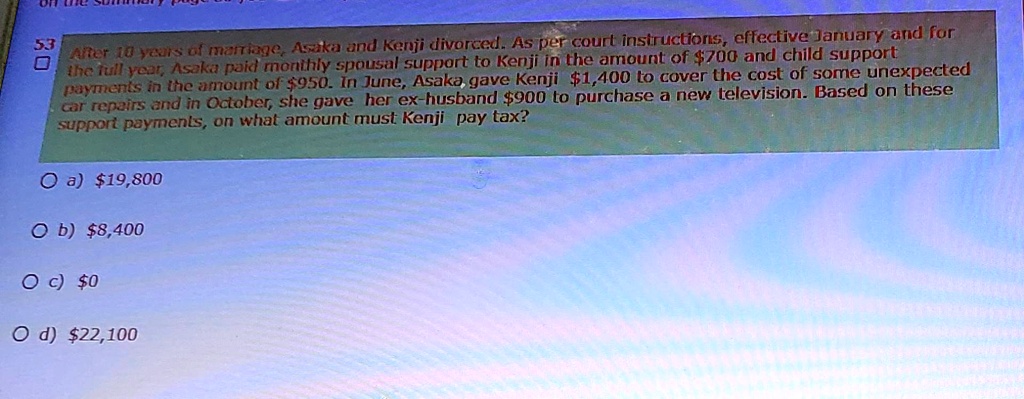
53 After 10 years of marriage, Asaka and Kenji divorced. As per court instructions, effective January and for the full year, Asaka paid monthly spousal support to Kenji in the amount of $700 and child support payments in the amount of $950. In June, Asaka gave Kenji $1,400 to cover the cost of some unexpected car repairs and in October, she gave her ex-husband $900 to purchase a new television. Based on these support payments, on what amount must Kenji pay tax? a) $19,800 b) $8,400 c) $0 d) $22,100
View Answer
divider
BEST MATCH

Compulsory Task In this compulsory task you will use pandas to select data from a dataset and explain the data retrieved for a given line of code. \[ \text { In [ ]: } \quad \text { import pandas as pd } \] You will use the same balance.txt dataset used in the example Jupyter notebook. Remember to ensure it is in the same folder as this notebook. In [ ]: Mdf = pd.read_csv('balance.txt', sep=' ') 1. Write the code that performs the action described in the following statements. \[ \begin{array}{l} \text { In [ ]: } \\ \text { In [ ]: Select the 'Limit' and 'Rating' columns of the first five observations } \\ \text { In [ ]: Select the first five observations with } 4 \text { cards } \end{array} \] 2. Write a short explanation in the form of a comment for the following lines of code. For example: \# Selects the first 5 rows, and all of the columns for those rows. \[ \text { df.iloc }[: 5,:] \] \[ \begin{array}{l} \text { In [ ]: M } \begin{array}{l} \text { \#[Add explanation here] } \\ \text { df.iloc }[:,:] \end{array} \\ \text { In [ ]: } \begin{array}{l} \text { \#[Add explanation here] } \\ \text { df.iloc }[5:, 5:] \end{array} \\ \text { In [ ]: } \begin{array}{l} \text { \#[Add explanation here] } \\ \text { df.iloc }[:, 0] \end{array} \\ \text { In [ ]: } \begin{array}{l} \text { \# [Add explanation here] } \\ \text { df.iloc }[9,:] \end{array} \end{array} \]

View Answer
divider
BEST MATCH

Find the first partial derivatives of the following function. $g(x,y,z) = 4x^5y^3 - 5x^4z^3 - 4y^4z^5$ The first partial derivatives of g are $\frac{\partial g}{\partial x} = \Box$, $\frac{\partial g}{\partial y} = \Box$, and $\frac{\partial g}{\partial z} = \Box$.

View Answer
divider
BEST MATCH

Question 7 (3 points) Given the exponential distribution $X \sim Exp(0.015)$ determine $P(29 < X < 50)$. (round to 4 decimal places) Your Answer: Answer Question 8 (3 points) Given the exponential distribution $X \sim Exp(0.018)$ determine mean. (round to 1 decimal place) Your Answer: Answer Question 9 (3 points) Given the exponential distribution $X \sim Exp(0.016)$ determine 68th percentile. (round up to the nearest integer) Your Answer: Answer

View Answer
divider
BEST MATCH

Perform the indicated matrix operation. (If an answer does not exist, enter DNE.)\begin{bmatrix} 2 & 1 \\ 4 & 3 \end{bmatrix} \begin{bmatrix} 0 & 1 \\ 1 & 0 \end{bmatrix}

View Answer
divider