Activity 7.14
Examining the Structure of the Thoracic Cage
The thoracic cage includes the 12 pairs of ribs and the sternum. These structures surround and protect the lungs,
heart, and other structures. In addition, movements of the ribs and sternum are essential for breathing.
A
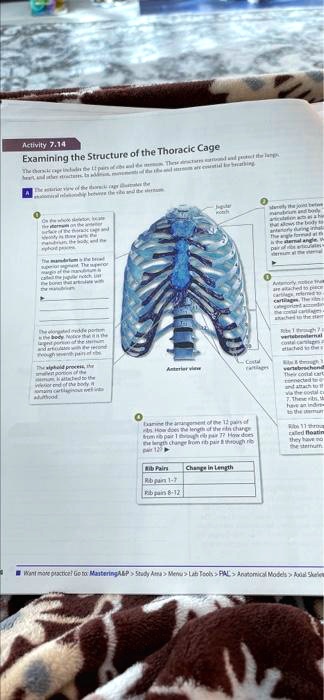
The anterior view of the thoracic cage illustrates the
anatomical relationship between the ribs and the sternum.
On the whole skeleton, locate
the sternum on the anterior
surface of the thoracic cage and
identify its three parts: the
manubrium, the body, and the
xiphoid process.
The manubrium is the broad
superior segment. The superior
margin of the manubrium has
called the jugular notch. List
the bones that articulate with
the manubrium.
The elongated middle portion
is the body. Notice that it is the
largest portion of the sternum
and articulates with the second
through seventh pairs of ribs.
The xiphoid process, the
smallest portion of the
sternum, is attached to the
inferior end of the body. It
remains cartilaginous well into
adulthood.
Anterior view
Examine the arrangement of the 12 pairs of
ribs. How does the length of the ribs change
from rib pair 1 through rib pair 7? How does
the length change from rib pair 8 through rib
pair 12?
Rib Pairs
Rib pairs 1-7
Rib pairs 8-12
Change in Length
Identify the joint between
the true ribs and their
transverse and body to
allow the rib to elevate
the angle during inhalation
that allow the rib to
pair of ribs at the ster-
num at the sternal angle.
Anatomy, notice that true
ribs 1 through 7 have
cartilages. The pieces
are attached to pieces
of costal cartilages
vertebrochondral
Ribs 1 through 7
costal cartilages that
attached to the
vertebrochondral
Ribs 8 through 10
Their costal carti-
vertebrochondral
connect to the costal
and attach to it via
the costal cartilage
7. These ribs
have an indirect
to the sternum.
Ribs 11 through 12 are
called floating ribs;
they have no
the sternum
Want more practice? Go to MasteringA&P > Study Area > Menu > Lab Tools > PAL > Anatomical Models > Axial Skeleton