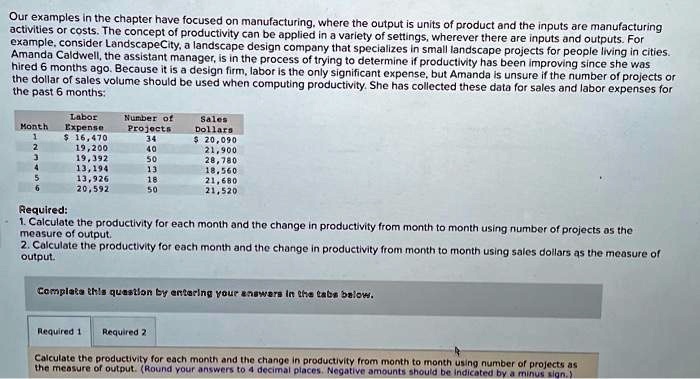
Our examples in the chapter have focused on manufacturing, where the output is units of product and the inputs are manufacturing
activities or costs. The concept of productivity can be applied in a variety of settings, wherever there are inputs and outputs. For
example, consider LandscapeCity, a landscape design company that specializes in small landscape projects for people living in cities.
Amanda Caldwell, the assistant manager, is in the process of trying to determine if productivity has been improving since she was
hired 6 months ago. Because it is a design firm, labor is the only significant expense, but Amanda is unsure if the number of projects or
the dollar of sales volume should be used when computing productivity. She has collected these data for sales and labor expenses for
the past 6 months:
Labor
Month
Expense
Number of
Projects
Sales
Dollars
1
$ 16,470
34
$ 20,090
2
19,200
40
21,900
3
19,392
50
28,780
4
13,194
13
18,560
5
13,926
18
21,680
6
20,592
50
21,520
Required:
1. Calculate the productivity for each month and the change in productivity from month to month using number of projects as the
measure of output.
2. Calculate the productivity for each month and the change in productivity from month to month using sales dollars as the measure of
output.
Complete this question by entering your answers in the tabs below.
Required 1 Required 2
Calculate the productivity for each month and the change in productivity from month to month using number of projects as
the measure of output. (Round your answers to 4 decimal places. Negative amounts should be indicated by a minus sign.).