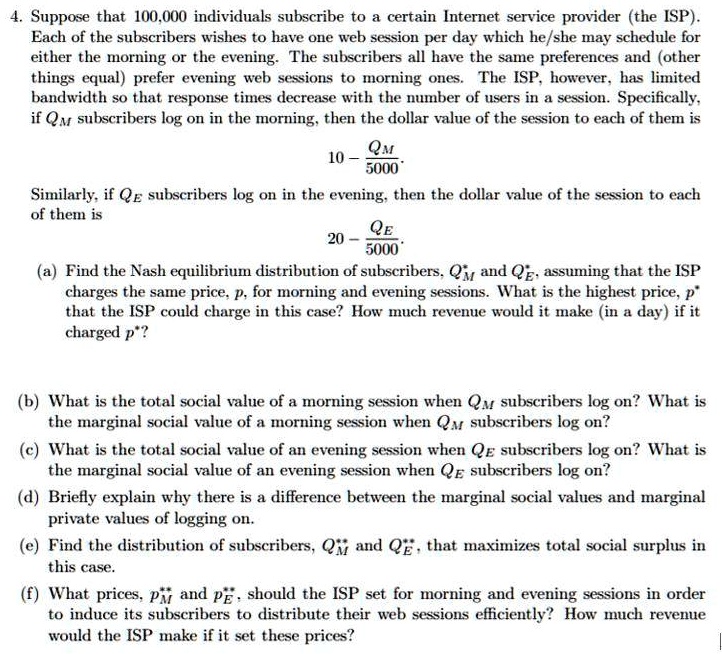
Suppose that 100,000 individuals subscribe to a certain Internet service provider (ISP). Each of the subscribers wishes to have one web session per day, which he/she may schedule for either the morning or the evening. The subscribers all have the same preferences and, other things being equal, prefer evening web sessions to morning ones. The ISP, however, has limited bandwidth, so that response times decrease with the number of users in a session. Specifically, if QM subscribers log on in the morning, then the dollar value of the session to each of them is QM - 5000. Similarly, if QE subscribers log on in the evening, then the dollar value of the session to each of them is QE - 5000.
a) Find the Nash equilibrium distribution of subscribers, QM and QE, assuming that the ISP charges the same price, p, for morning and evening sessions. What is the highest price, p, that the ISP could charge in this case? How much revenue would it make in a day if it charged p*?
b) What is the total social value of a morning session when Q subscribers log on? What is the marginal social value of a morning session when Q subscribers log on?
c) What is the total social value of an evening session when QE subscribers log on? What is the marginal social value of an evening session when QE subscribers log on?
d) Briefly explain why there is a difference between the marginal social values and marginal private values of logging on.
e) Find the distribution of subscribers, QN and QE, that maximizes total social surplus in this case.
f) What prices, PM and PE, should the ISP set for morning and evening sessions in order to induce its subscribers to distribute their web sessions efficiently? How much revenue would the ISP make if it set these prices?