Ace - AI Tutor
Ask Our Educators
Textbooks
My Library
Flashcards
Scribe - AI Notes
Notes & Exams
Download App
ricardo cole

ricardo c.

Divider

Questions asked

BEST MATCH

Which symptoms reported by the patient immediately following the surgical removal of the thyroid and parathyroid gland requires intervention by the RN? Select the "2" findings that require immediate follow-up. Foot cramps Dizziness Earache Hand tremors Increased appetite

View Answer
divider
BEST MATCH

This problem has two parts. Part 1: You are given angle $\theta$ is in standard position with terminus in the third quadrant. In what quadrants can the terminus of angle $2\theta$ lie? Check all that apply. I II III IV In what quadrants can the terminus of angle $\frac{\theta}{2}$ lie? Check all that apply. I II III IV If $\sin(\theta) = -\frac{4}{7}$, as illustrated, determine the following two values. $\cos(2\theta) =$ (Give the exact value) $\sin(2\theta) =$ (Give the exact value)

View Answer
divider
BEST MATCH

What describes a measure of how much a solution or liquid can neutralize acids or bases? Select the best answer Methanogenesis pH Alkalinity Buffer capacity

View Answer
divider
BEST MATCH

Which is true for molecular assays that detect MRSA? Group of answer choices False positives may occur due to empty cassettes or nonfunctional mec genes. They detect mecA, mecB, and mecC. They are less sensitive than culture-based methods. Differentiating from MR-S epidermidis is not possible. Only tests for infection control surveillance exist.

View Answer
divider
BEST MATCH

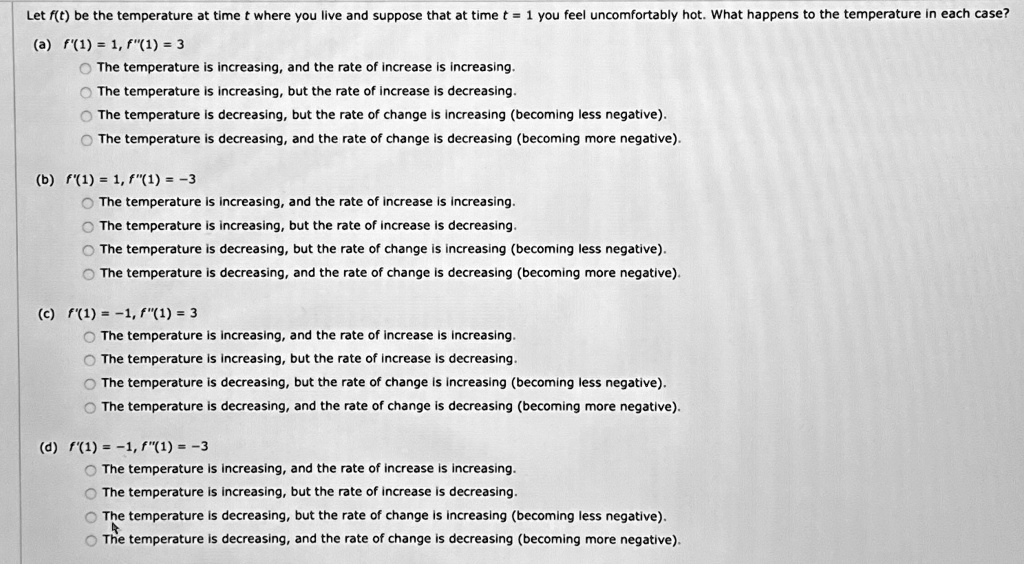
Let f(t) be the temperature at time t where you live and suppose that at time t = 1 you feel uncomfortably hot. What happens to the temperature in each case? (a) $f'(1) = 1$, $f''(1) = 3$ The temperature is increasing, and the rate of increase is increasing. The temperature is increasing, but the rate of increase is decreasing. The temperature is decreasing, but the rate of change is increasing (becoming less negative). The temperature is decreasing, and the rate of change is decreasing (becoming more negative). (b) $f'(1) = 1$, $f''(1) = -3$ The temperature is increasing, and the rate of increase is increasing. The temperature is increasing, but the rate of increase is decreasing. The temperature is decreasing, but the rate of change is increasing (becoming less negative). The temperature is decreasing, and the rate of change is decreasing (becoming more negative). (c) $f'(1) = -1$, $f''(1) = 3$ The temperature is increasing, and the rate of increase is increasing. The temperature is increasing, but the rate of increase is decreasing. The temperature is decreasing, but the rate of change is increasing (becoming less negative). The temperature is decreasing, and the rate of change is decreasing (becoming more negative). (d) $f'(1) = -1$, $f''(1) = -3$ The temperature is increasing, and the rate of increase is increasing. The temperature is increasing, but the rate of increase is decreasing. The temperature is decreasing, but the rate of change is increasing (becoming less negative). The temperature is decreasing, and the rate of change is decreasing (becoming more negative).
View Answer
divider
BEST MATCH

$g(z) = \frac{z^2 - 4z + 4}{z - 3} \cdot \frac{z^2 - 7z + 12}{z - 2}$

View Answer
divider
BEST MATCH

what is the anesthesia code for a 5 year old female underwent percutaneous liver biopsy under general anesthesia

View Answer
divider
BEST MATCH

QUESTION 8 The on-delay timer (TON) starts timing when the timer's: ladder rung switches from false to true. ladder rung switches from true to false. accumulated value equals its preset value accumulated is greater than its preset value

View Answer
divider
BEST MATCH

Determine the propagation direction (and direction) and the polarization state (polarization type and direction of rotation) of the TEM electromagnetic waves listed below and represented by the electric field (E) or magnetic field (H) phasor or value instantaneous electric (E) or magnetic (H) field [in the expressions below, spherical (r, $\theta$, $\Phi$) and rectangular (x,y,z) coordinate systems are used]: (i) $\mathcal{H} = \hat{a}_\theta H_0 cos(\omega t - kr) + \hat{a}_\phi \frac{H_0}{2} sin(\omega t - kr)$, where $H_0$ is a real amplitude. (ii) $E = (\hat{a}_y E_1 + \hat{a}_z E_2) \frac{e^{-jkx}}{x}$, being $E_2 = \frac{3}{2} E_1$ complex amplitudes. In the expressions above, $\hat{a}_p$ represents the unit vector in the p direction; k is the wave number; $\omega$ is the angular frequency and t is the time.

View Answer
divider
BEST MATCH

H2 gas can be purified by diffusing through a palladium (Pd) sheet. At 600°C, a 6 mm-thick Pd sheet whose area is 0.25 m^2 is used for H2 purification. Determine the hydrogen flow through the entire sheet in kg/s. Here, the diffusion coefficient (of H atom in Pd at 600°C) D is 1.7x10^-8 m^2/s. The H concentrations at the high- and low-pressure sides of the Pd sheet are 2.0 kg/m^3 and 0.4 kg/m^3, respectively. Assume steady-state diffusion.

View Answer
divider