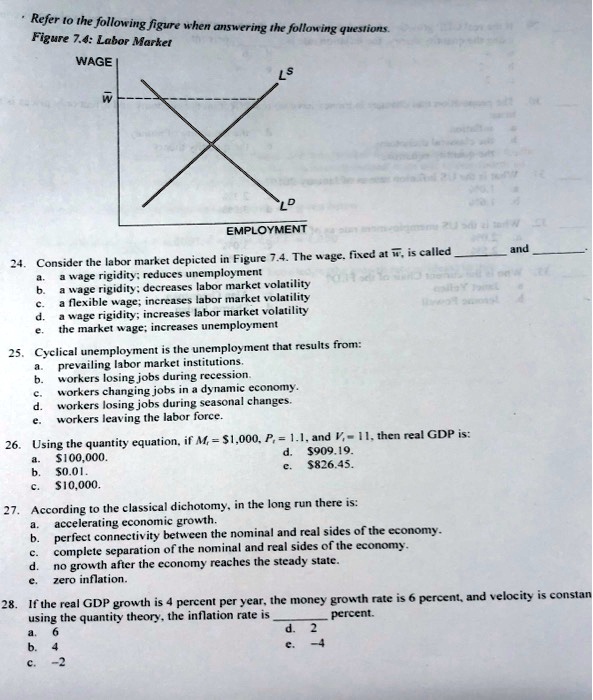
Refer to the following figure when answering the following questions.
Figure 7.4: Labor Market
WAGE
LS
W
LD
EMPLOYMENT
24. Consider the labor market depicted in Figure 7.4. The wage, fixed at $w$, is called ______ and ______.
a. a wage rigidity; reduces unemployment
b. a wage rigidity; decreases labor market volatility
c. a flexible wage; increases labor market volatility
d. a wage rigidity; increases labor market volatility
e. the market wage; increases unemployment
25. Cyclical unemployment is the unemployment that results from:
a. prevailing labor market institutions.
b. workers losing jobs during recession.
c. workers changing jobs in a dynamic economy.
d. workers losing jobs during seasonal changes.
e. workers leaving the labor force.
26. Using the quantity equation, if $M_t = \$1,000$, $P_t = 1.1$, and $V_t = 11$, then real GDP is:
a. $100,000.
b. $0.01.
c. $10,000.
d. $909.19.
e. $826.45.
27. According to the classical dichotomy, in the long run there is:
a. accelerating economic growth.
b. perfect connectivity between the nominal and real sides of the economy.
c. complete separation of the nominal and real sides of the economy.
d. no growth after the economy reaches the steady state.
e. zero inflation.
28. If the real GDP growth is 4 percent per year, the money growth rate is 6 percent, and velocity is constant, using the quantity theory, the inflation rate is ______ percent.
a. 6
b. 4
c. $-2$
d. 2
e. $-4$