Ace - AI Tutor
Ask Our Educators
Textbooks
My Library
Flashcards
Scribe - AI Notes
Notes & Exams
Download App
ricardo segarra

ricardo s.

Divider

Questions asked

BEST MATCH

Which of the following statements about comparative advantage is not true economist use the principle of comparative advantage to emphasize the potential benefits of free trade the principle of comparative advantage applies to countries as well as as individuals comparative advantage is determined by which person or group of person can produce a given quantity of a good using the fest resources or a country may have a competitive advantage in producing a good even though it lacks an absolute advantage and producing that good good

View Answer
divider
BEST MATCH

in the inductor circuit, the peak voltage proceeds to current in each cycle by time interval

View Answer
divider
BEST MATCH

If a car has an internal volume of 2600 liters, at standard atmospheric pressure, how many moles of gas would it contain on a day when the temperature was 15°C?

View Answer
divider
BEST MATCH

6. Based on your results, discuss how effective is the evaporation of water at removing excess heat from your body (sweating). It is really effective on the

View Answer
divider
BEST MATCH

Identify and reflect on how the use of effective strategies for SEL and PBIS are interconnected in the classroom and connected to family/community.

View Answer
divider
BEST MATCH

Your mother has albinism, which is a recessive trait. You learn that your spouse's mother also has albinism. What are the odds that your first child will also have albinism? 1/4 1/2 3/4 1 not enough information

View Answer
divider
BEST MATCH

10. Below is a mechanism for a chemical reaction. Which energy diagram would go with this mechanism? Step 1: (CH$_3$)$_3$COH + H$^+$ \rightarrow (CH$_3$)$_3$COH$_2$$^+$ (fast) Step 2: (CH$_3$)$_3$COH$_2$$^+$ \rightarrow (CH$_3$)$_3$C$^+$ (slow) Step 3: (CH$_3$)$_3$C$^+$ + Br$^-$ \rightarrow (CH$_3$)$_3$CBr (fast)

View Answer
divider
BEST MATCH

1) Find the state transition matrix \(\Phi(t)\) for the following cases: a) \(A = \begin{bmatrix} 0 & 1 \ -12 & -7 \end{bmatrix}\) b) \(A = \begin{bmatrix} -2 & 1 & 0 \ 0 & -4 & 1 \ 0 & 0 & -4 \end{bmatrix}\) 2) Find the time response of the system in Question 1.a to the unit-step and \(x_0 = \begin{bmatrix} 1 & 2 \end{bmatrix}^T\) \(\begin{bmatrix} \dot{x}_1 \ \dot{x}_2 \end{bmatrix} = \begin{bmatrix} 0 & 1 \ -12 & -7 \end{bmatrix} \begin{bmatrix} x_1 \ x_2 \end{bmatrix} + \begin{bmatrix} 0 \ 1 \end{bmatrix} u\)

View Answer
divider
BEST MATCH

The demand for a product is likely to be more elastic: A) The smaller the fraction of consumer income spent on the product B) In the short run than in the long run C) The more broadly defined the product D) The greater the number of available substitutes for the product

View Answer
divider
BEST MATCH

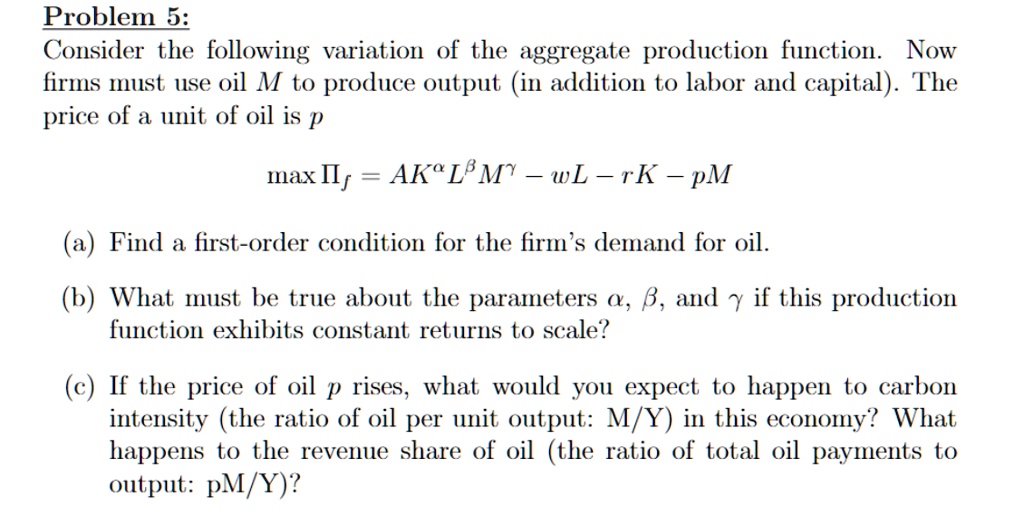
Problem 5: Consider the following variation of the aggregate production function. Now firms must use oil $M$ to produce output (in addition to labor and capital). The price of a unit of oil is $p$ $\max \Pi_f = AK^\alpha L^\beta M^\gamma - wL - rK - pM$ (a) Find a first-order condition for the firm's demand for oil. (b) What must be true about the parameters $\alpha$, $\beta$, and $\gamma$ if this production function exhibits constant returns to scale? (c) If the price of oil $p$ rises, what would you expect to happen to carbon intensity (the ratio of oil per unit output: $M/Y$) in this economy? What happens to the revenue share of oil (the ratio of total oil payments to output: $pM/Y$)?
View Answer
divider